
Home renovation insurance UK: what you need to know
Discover essential insights on home renovation insurance UK. Protect your property and ensure coverage for renovations like extensions and conversions.

Home renovation insurance UK: what you need to know
Home renovation insurance UK is specialist cover that protects your property, your building works, and your legal liabilities during a renovation project that standard home insurance typically excludes. If you are planning a rear extension, loft conversion, or any structural work in Hounslow, your existing home insurance policy almost certainly will not cover you once the builders arrive. Standard home insurance excludes structural projects like extensions and loft conversions, treating them as a material change in risk. The industry term for the cover you need is “contract works insurance,” though most homeowners search for it as renovation insurance. Understanding both terms helps you ask the right questions and buy the right policy.
What does home renovation insurance cover?
Renovation insurance UK fills the gaps that standard policies leave wide open. A specialist policy typically bundles several types of cover into one arrangement, each protecting a different part of your project.
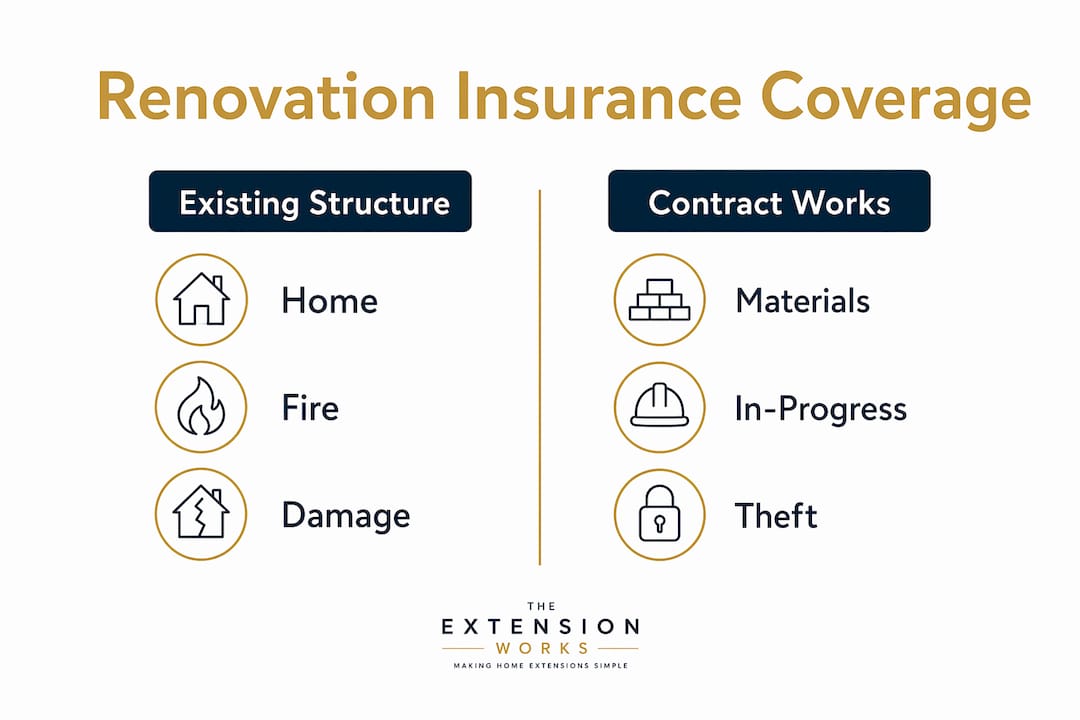
Cover for the existing structure protects the parts of your home that were already there before work began. A fire that spreads from a builder’s blowtorch, or a roof left exposed during a loft conversion, falls under this section. Without it, your standard insurer may refuse a claim because the works constituted an undisclosed material change in risk.

Contract works cover protects the new building work itself, including materials on site and partially completed structures. Theft of copper pipework, storm damage to a freshly laid roof, or a collapsed wall mid-build are all scenarios this section addresses.
Public liability insurance covers injury or property damage claims made by third parties, such as a neighbour whose fence is damaged by falling scaffolding. Employer’s liability cover is also relevant if you directly employ any workers on site, which is a legal requirement in the UK.
Alternative accommodation cover pays for you to stay elsewhere if the works make your home uninhabitable. This is particularly relevant for Hounslow homeowners undertaking rear extensions, where kitchen demolition can make the property unliveable for weeks.
The table below summarises the core cover types and what each one protects:
| Cover type | What it protects |
|---|---|
| Existing structure | Your home as it stands before works begin |
| Contract works | New build work, materials, and partially completed structures |
| Public liability | Third-party injury or property damage claims |
| Employer’s liability | Claims from workers you directly employ |
| Alternative accommodation | Temporary housing costs if the property is uninhabitable |
Pro Tip: Ask your insurer whether contract works cover is written on a “lost or damaged” basis rather than a “named perils” basis. Lost or damaged cover allows faster claims without needing to prove negligence, which keeps your project moving.
Common misconceptions UK homeowners make about renovation cover
The most dangerous assumption a homeowner can make is that their builder’s insurance covers everything. Builder’s public liability insurance covers third-party injury claims but does not cover damage to your property, fire, theft, or site accidents. That gap is entirely your responsibility unless you hold a specialist policy.
A second widespread misconception is that your existing home insurance will simply stretch to cover the works. Failing to inform your insurer about structural projects can invalidate your entire home insurance policy, not just the renovation element. That means a burst pipe in an untouched bedroom could go uncovered because you never disclosed the extension at the back of the house.
Unoccupancy clauses catch many homeowners off guard. Standard home insurance policies often become void if the property is unoccupied for more than 30 days. Renovations frequently push properties past that threshold, particularly when structural works make them uninhabitable. Specialist unoccupied property cover fills this gap directly.
The distinction between contract works insurance and renovation insurance also trips people up. Contract works insurance is the technical term used by underwriters and covers the physical building work. Renovation insurance is the broader consumer-facing term that typically bundles contract works, public liability, and existing structure cover together. Knowing the difference helps you verify that a policy you are comparing actually covers all three layers.
Pro Tip: Before signing a building contract, check who insures the site. The contract must state clearly whether the builder or the homeowner is responsible for insuring the existing structure and the new works. Never assume.
How to choose the right renovation insurance policy in the UK
Selecting the right policy requires a methodical approach. Rushing this step is one of the most common and costly mistakes Hounslow homeowners make when planning extensions.
-
Define the full scope of works. List every structural change, including demolition, groundworks, and roof alterations. Insurers price policies based on the nature and scale of works, so vague descriptions lead to inadequate cover.
-
Set the correct sums insured. The sum insured for the existing structure should reflect the full rebuild cost of your home, not its market value. The sum insured for contract works should cover the total contract value including materials and labour. Underinsuring either figure leaves you exposed to partial claim settlements.
-
Clarify the contract. Contracts must explicitly state who is responsible for insuring the site and the existing structure. If the contract is silent on this point, you carry the risk by default.
-
Check liability limits. Public liability cover of at least £2,000,000 is standard for most residential projects. For larger extensions or projects involving multiple contractors, £5,000,000 is more appropriate.
-
Match policy duration to your project timeline. Specialist renovation policies run from a few months to several years and can be extended if your timeline slips, though extensions typically carry an additional premium. Build a buffer into your policy duration from the start.
-
Notify your existing insurer. Even if you take out a specialist renovation policy, you must inform your standard home insurer about the works. Failure to do so can invalidate your standard policy independently of your renovation cover.
Pro Tip: Get your extension costs and scope confirmed in writing before approaching insurers. A fixed-price contract makes it far easier to set accurate sums insured and avoid disputes at claim time.
Real scenarios: how renovation insurance responds in practice
Understanding how a policy responds in practice is more useful than reading the policy wording in isolation. Three scenarios illustrate the most common claims situations.
Fire during an extension build. A blowtorch used during pipework ignites timber framing. The fire spreads to the existing roof structure. Contract works cover pays for the damaged new build. Existing structure cover pays for the original roof. Without both sections active, the homeowner bears one of those costs personally.
Theft of materials from site. Copper pipework and electrical cabling are stolen overnight from an unenclosed site. Contract works cover on a lost or damaged basis pays out without requiring the homeowner to prove who was negligent. Named perils policies may require evidence of forced entry or a specific listed cause, slowing the claim considerably.
Project delay and unoccupancy. A structural issue discovered during groundworks pushes the project timeline out by six weeks. The homeowner has been staying with family and the property has been unoccupied for 35 days. Standard policies void at 30 days unoccupancy, so without specialist cover, any damage during that period goes uncompensated.
The table below maps common renovation risks to the cover type that responds:
| Risk event | Cover type that responds |
|---|---|
| Fire spreading to existing structure | Existing structure cover |
| Theft of materials on site | Contract works cover |
| Neighbour injured by falling scaffolding | Public liability |
| Property unoccupied beyond 30 days | Specialist unoccupied property cover |
| Project overrun requiring extended cover | Policy extension (additional premium) |
Key takeaways
Renovation insurance UK is specialist cover that protects your existing home, your new building works, and your legal liabilities during structural projects that standard home insurance excludes by default.
| Point | Details |
|---|---|
| Standard policies fall short | Home insurance typically excludes structural works and may be invalidated if works go undisclosed. |
| Builder’s insurance is not enough | Public liability covers third parties only; homeowners need separate cover for their property and materials. |
| Unoccupancy is a hidden risk | Properties empty for more than 30 days often lose standard cover; specialist policies fill this gap. |
| Lost or damaged basis is preferable | This policy type settles claims faster without requiring proof of negligence. |
| Contracts must assign insurance responsibility | Written contracts should state clearly who insures the site, the existing structure, and the new works. |
What I have learned from watching homeowners get this wrong
Most homeowners I have spoken to about renovation insurance discover the problem too late. They sign a building contract, the works begin, and only when something goes wrong do they realise their standard home insurance has a clause that voids cover the moment structural alterations start. By then, the options are limited and expensive.
The single biggest oversight is treating the builder’s insurance as a complete solution. Builders carry public liability because it protects them from third-party claims. It does not protect your kitchen, your roof, or the new extension walls from fire, flood, or theft. That is your problem, and a specialist policy is the only clean answer.
I have also seen homeowners underinsure their contract works because they used a rough estimate rather than the actual contract value. When a claim arises mid-build, the insurer applies average, which means the payout is proportionally reduced. A £150,000 extension insured for £80,000 does not pay out £150,000 when something goes wrong.
My strongest advice is to engage your insurer before you sign the building contract, not after. Clear communication with insurers before works start is the single most effective way to avoid claim refusals. Read the unoccupancy clause in your existing policy today. If you are planning a rear extension in Hounslow, the timeline alone may push you past the threshold without you realising it.
— Esskay
Planning a rear extension in Hounslow? The Extension Works can help
Getting your insurance right starts with knowing exactly what you are building and what it will cost. Vague project scopes lead to vague policies and disputed claims.
The Extension Works specialises in single-storey rear extensions across the UK, including Hounslow, and provides fixed VAT-inclusive prices from the outset. A confirmed contract value makes it straightforward to set accurate sums insured for both contract works and your existing structure. Their instant online quote tool gives you a real price in minutes, with live 3D modelling so you can see exactly what you are building before a single brick is laid. Every project comes with a 12-month workmanship warranty and a dedicated team managing the process from planning through to final sign-off. Visit The Extension Works to get started.
FAQ
Do I need renovation insurance for a home extension?
Yes. Standard home insurance excludes contract works and treats structural alterations as a material change in risk, which can void your existing policy if undisclosed.
Does my builder’s insurance cover my property during renovation?
No. Builder’s public liability insurance covers third-party injury claims only. It does not cover damage to your property, theft of materials, or fire on site.
How long does renovation insurance last?
Specialist renovation policies run from a few months to several years. They can be extended if your project overruns, though extensions usually carry an additional premium.
What is the difference between contract works and renovation insurance?
Contract works insurance is the technical underwriting term covering the physical build. Renovation insurance is the broader consumer term that typically bundles contract works, public liability, and existing structure cover together.
What happens if my property is unoccupied during renovation?
Standard home insurance commonly voids cover after 30 days of unoccupancy. If your renovation pushes the property past that threshold, you need specialist unoccupied property cover to remain protected.
Recommended
- The Extension Works | Premium UK Rear Extensions
- Permitted Development & Extension Rules 2026 — How Big Can You Build? | The Extension Works
- Instant Extension Quote Tool — Design & Price Your Rear Extension Online | The Extension Works
- Extension Gallery — Real Rear Extensions, Before & After | The Extension Works