
Planning fees for an extension: what England homeowners need to know
Discover essential planning fees for an extension in England, from application costs to necessary surveys, and budget effectively for your project.
Planning fees for an extension: what England homeowners need to know
The standard statutory fee for a householder planning application in England is typically around £548 for alterations or extensions to a single dwellinghouse, reflecting recent indexation. On top of that, if you submit through the Planning Portal and your council fee exceeds £100, you will also pay a mandatory service charge of £75.83 plus VAT. That is the first number most homeowners miss.
Here is what to budget for immediately:
- Statutory planning fee: around £548 for a standard householder extension (check the current indexed figure for your council)
- Planning Portal service charge: £75.83 plus VAT for online submissions where the council fee exceeds £100
- Planning drawings: commonly in the range of £1,000 to £2,500 for a single-storey extension
- Architect or planning consultant: costs vary widely depending on scope
- Specialist surveys (ecology, trees, drainage): generally budget a few hundred pounds per report if required
- Lawful Development Certificate (LDC): typically around half the equivalent planning fee where permitted development is arguable
Use the Planning Portal fee calculator to confirm the exact figure before you submit. Fees change annually now, so a figure you saw quoted online six months ago may already be out of date.
Pro Tip: Call your local planning authority (LPA) before you submit. Confirm the fee category and the exact amount they expect. An incorrect fee means your application will not be validated, and you will lose time, not money, but time is often the more painful loss on a building project.
Key takeaways
Planning fees for an extension in England consist of a statutory council fee (currently around £548 for a standard householder application), a Planning Portal service charge of £75.83 plus VAT for online submissions, and professional costs that typically add £2,000–£5,000 before construction begins.
| Point | Details |
|---|---|
| Statutory householder fee | Currently around £548 for a standard extension; check the annual indexation table for the current figure. |
| Planning Portal service charge | £75.83 plus VAT applies to online submissions where the council fee exceeds £100. |
| Annual indexation | Fees are CPI-adjusted each April; always verify against the GOV.UK indexation table before submitting. |
| Professional costs | Planning drawings, architect fees, and any specialist surveys typically add £2,000–£5,000 to the planning stage. |
| The Extension Works | Handles planning submission and LPA liaison within its fixed-price service; statutory fees are separate and payable to the council. |
Table of Contents
- How are planning fees for extensions set in England?
- What do common planning fees look like in practice?
- Which applications attract no planning fee?
- What other costs should you budget for beyond the council fee?
- How do you calculate the correct fee and pay without causing delays?
- When can you avoid planning permission altogether?
- What happens after you pay: validation, decisions and next steps
- How The Extension Works handles planning fees
- The part of planning costs most homeowners underestimate
- Planning made simpler with The Extension Works
- Sources
How are planning fees for extensions set in England?
Planning fees in England are not set by your council. They are set nationally under the Town and Country Planning (Fees for Applications, Deemed Applications, Requests and Site Visits) (England) Regulations 2012, as amended, and every local planning authority is required to apply them. Your council collects the fee, but it has no discretion over the amount.
The 2012 Regulations have been amended several times since their introduction. The most significant recent change for homeowners is the introduction of annual CPI-linked indexation from 1 April 2025. Each year, fees are adjusted by the Consumer Prices Index figure for the preceding September, then rounded to the nearest £1. The government publishes an official indexation table setting out the updated figures, and the 2026 table confirms the uplift that applied from 1 April 2026.
What this means in practice: the fee you read on a forum or a cost guide from 2023 or 2024 may already be wrong. Indexation means fees are a moving target, and the only reliable source is the GOV.UK guidance page or the current indexation PDF, checked at the time you are budgeting.
The Gov explains that fee categories reflect the processing workload for different types of application. There are 13 categories in the regulations, covering everything from householder works to major commercial developments. For most homeowners extending a single house, the relevant category is straightforward, but mixed proposals (for example, an extension combined with a change of use) require the LPA to determine which categories apply and how to combine them.
What do common planning fees look like in practice?
The table below draws on Bradford Council’s published fee schedule, which reproduces the national figures, to show the fees most relevant to domestic extension projects.
A worked example: you want a single-storey rear extension on your house in Sutton. The project falls within the householder category, so the statutory fee is £548. You submit via the Planning Portal, so add £75.83 + VAT for the service charge. Total statutory outlay before any professional fees: roughly £639.
A few important caveats. Fees are indexed annually, so £548 is the figure at the time of writing; always verify against the current indexation table. Mixed applications, where your extension also involves, say, converting a garage to a habitable room, may attract fees from more than one category. In those cases, contact your LPA directly rather than assuming a single fee applies.
- Always use the Planning Portal fee calculator as your first check
- Cross-reference with your own council’s published fee schedule
- For mixed or complex proposals, email the LPA’s planning team before submission
Which applications attract no planning fee?
Not every application costs money. Several categories are exempt from the statutory fee, and knowing them can save you from paying unnecessarily.
Common fee-exempt application types include:
- Listed building consent: no fee is payable, though the application itself is still required
- Conservation area consent for demolition: exempt in most cases
- Works for disabled access: alterations to a dwellinghouse solely to improve access or facilities for a disabled resident are fee-exempt under the regulations
- Applications made by a parish or community council for development on their own land in certain circumstances
- Re-submissions within 12 months of a refused application for the same development: one free re-submission is permitted under the regulations, subject to conditions
The practical consequence of an exemption is not that the process disappears. You still need to submit a valid application with the correct supporting documents. An exemption only removes the fee; it does not remove the LPA’s right to refuse or to request further information.
Pro Tip: If you believe an exemption applies to your project, do not simply submit with no fee and hope for the best. Get written confirmation from the LPA first. An application submitted without a fee, where the LPA believes one is due, will be returned as invalid and you will lose weeks.
What other costs should you budget for beyond the council fee?
The statutory fee is usually the smallest line item in the planning budget. Professional costs routinely dwarf it, and this is where homeowners are most often caught out.
Here are the typical costs to plan for, based on independent cost guides for UK householder projects:
- Planning drawings (draughtsperson or technician): £1,000–£2,500 for a single-storey rear extension
- Architect full service (design through to planning submission): £2,000–£6,000+
- Planning consultant: £500–£2,000+ depending on complexity and whether a planning statement is needed
- Structural engineer (preliminary calculations for planning): £400–£1,000
- Specialist surveys: ecology surveys, tree reports (BS 5837), drainage assessments, and heritage statements each typically cost £300–£800 per report; councils request these when the site or proposal triggers a specific policy requirement
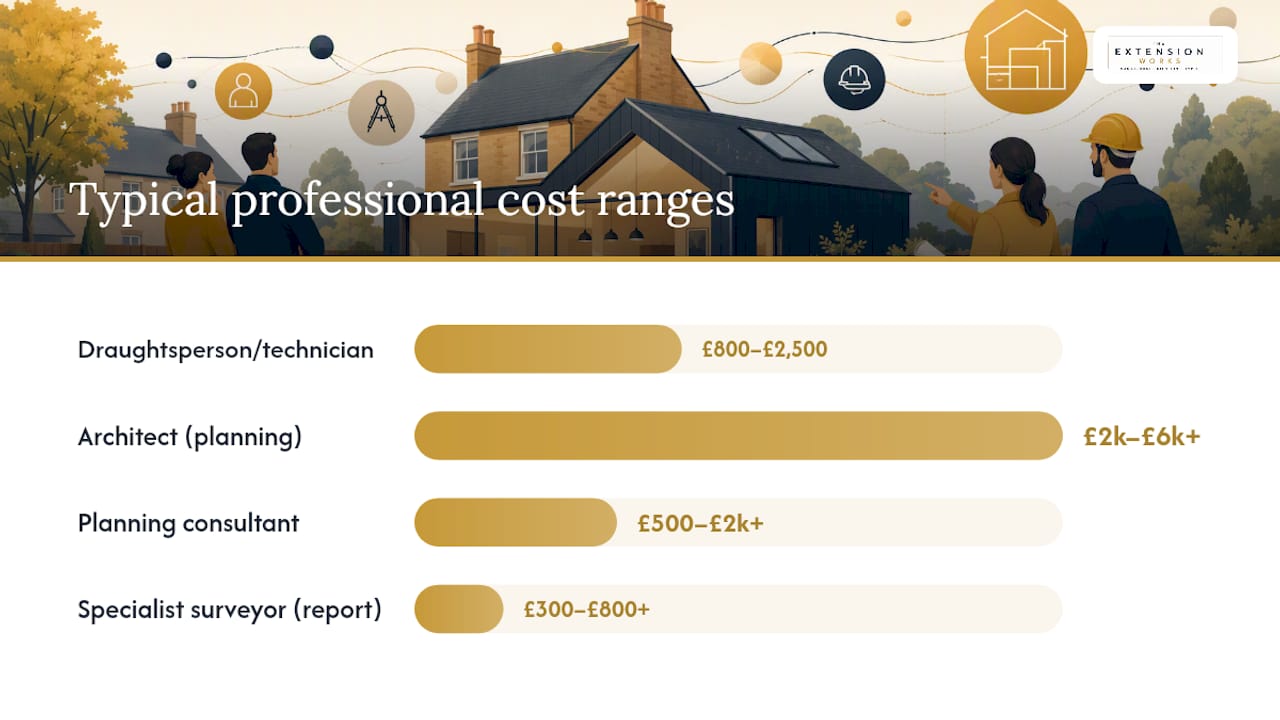
The table below gives a rough sense of the range by provider type:
| Professional | Lower end | Typical mid-range | Higher end |
|---|---|---|---|
| Draughtsperson/technician | £800 | £1,000–£2,500 | £2,500 |
| Architect (planning stage) | £2,000 | £2,000–£6,000+ | £6,000+ |
| Planning consultant | £500 | £500–£2,000+ | £2,000+ |
| Specialist surveyor (per report) | £300 | £548 | £800+ |
When councils request specialist surveys, they typically do so at the validation stage or via a pre-application advice response. An ecology survey, for example, is commonly triggered by the presence of trees, outbuildings, or a site near a designated habitat. Budget for at least one specialist report as a contingency if your garden has mature trees or your property is in a conservation area.

The LDC shortcut. Where your project likely falls within permitted development but you want legal certainty, a Lawful Development Certificate is worth considering. The fee for a proposed LDC is typically half the equivalent full planning fee, so roughly £274 for a householder project. It does not grant planning permission, but it gives you a formal record that the works are lawful, which matters when you come to sell. For a rear extension planning project that sits comfortably within PD limits, an LDC often costs less overall than a full application once professional time is factored in.
For a deeper look at what drawings cost and what they need to show, the guide to extension planning drawings covers the scope in detail.
How do you calculate the correct fee and pay without causing delays?
Getting the fee wrong is one of the most common reasons applications are returned unvalidated. Here is the process, step by step.
- Identify your application type. Is it a householder application, a full application, a prior approval, or an LDC? The category determines the fee. Most single-storey rear extensions on a house fall under the householder category.
- Use the official fee calculator. The Planning Portal’s fee calculator (accessible via the Gov page) walks you through the category questions and produces the correct fee. Do this before you prepare any documents.
- Check the current indexation table. From 1 April 2025, fees are adjusted annually. Confirm the figure against the latest indexation table rather than relying on a figure you have seen elsewhere.
- Add the Planning Portal service charge if submitting online. For applications with a council fee above £100, the Planning Portal adds £75.83 + VAT at checkout. This is mandatory for online submissions through the portal and is not refundable.
- Consider paying directly to the LPA. Some local authorities still accept direct payment (bank transfer or cheque) outside the Planning Portal. This avoids the service charge. Check with your LPA whether this option is available before assuming it is.
- Submit with the correct fee. Payment is made at the point of submission. The LPA will not begin processing your application until the correct fee is received.
Critical warning: submitting with an incorrect fee will result in your application being returned as invalid. The Planning Portal is explicit that incorrect fees delay validation. You will need to resubmit, which resets the statutory clock. Fees are generally non-refundable once paid, even if you withdraw the application or the LPA fails to determine it within the statutory period.
One more thing on refunds: if the LPA does not determine your application within the statutory timeframe (eight weeks for householder applications, 13 weeks for major applications), you cannot reclaim the fee, but you can appeal for non-determination. That appeal right is separate from any refund entitlement, and the two should not be confused.
When can you avoid planning permission altogether?
Permitted development (PD) rights allow many homeowners to extend without a full planning application. For a single-storey rear extension, the key limits under current PD rules are:
- Detached house: up to 4 metres depth from the original rear wall
- Semi-detached or terraced house: up to 3 metres depth
- Height: no more than 4 metres at the ridge, and no more than 3 metres at the eaves within 2 metres of a boundary
- The extension must not cover more than half the garden area, and must not project beyond the principal elevation
If your project exceeds those depth limits but stays within 8 metres (detached) or 6 metres (semi/terraced), you may still proceed under the larger home extension prior approval route, also called the neighbour consultation scheme. This requires a prior approval application with a flat fee of £120, which is considerably lower than a full householder application. The LPA notifies neighbours and has 42 days to respond; if it does not, prior approval is deemed granted.
For a full breakdown of what you can build without permission, the permitted development and extension rules guide covers the current limits in detail.
Caveat: PD rights do not apply universally. They are removed or restricted in Article 4 Direction areas, conservation areas, listed buildings, and some new-build estates where the developer removed PD rights via a planning condition. Check your title register and your council’s interactive map before assuming PD applies to your property.
- If you are in any doubt, an LDC is the safest route: it costs roughly half the full planning fee and gives you a formal, legally binding confirmation
- Never rely solely on a neighbour’s experience or an online forum post to confirm PD status for your specific property
What happens after you pay: validation, decisions and next steps
Paying the fee does not start the statutory clock. Validation does. The LPA checks that your application is complete (correct fee, correct forms, correct drawings, correct supporting documents) before it registers the application and begins the determination period.
Here is the typical sequence:
- Submission: application and fee submitted via the Planning Portal or directly to the LPA
- Validation check: LPA reviews completeness, usually within 5–10 working days; an incorrect fee stops the process here
- Registration: once valid, the application is registered and the statutory clock starts
- Statutory determination period: eight weeks for householder applications; 13 weeks for major applications
- Decision: approval, refusal, or approval with conditions
- Post-decision: if refused, you may appeal to the Planning Inspectorate within 12 weeks of the decision date; if the LPA fails to determine within the statutory period, you may appeal for non-determination
A few points worth knowing. Conditions attached to an approval sometimes require a further fee, for example a fee for discharging pre-commencement conditions. These are separate from the original application fee and are easy to overlook when budgeting. Also, if your application is refused and you resubmit within 12 months for the same development, the re-submission is free under the one free go rule, though professional costs for revised drawings will still apply.
For a broader view of what the build timeline looks like from planning through to completion, the guide to extension project management sets out the full sequence.
How The Extension Works handles planning fees
Managing planning fees is one of the practical headaches The Extension Works takes off your plate. When you book a single-storey rear extension through The Extension Works, the service covers the preparation and submission of your planning application, including the architectural drawings, structural calculations, and all LPA correspondence. The statutory planning fee itself is payable to the council and is separate from The Extension Works’ fixed build price, but the team manages the payment logistics and confirms the correct fee category before submission. This removes the risk of an incorrect fee causing a validation delay.
What the bundled service includes at the planning stage:
- Architectural drawings prepared to planning submission standard
- Planning application preparation and submission
- Liaison with the LPA throughout the determination period
- Structural calculations (where required at planning stage)
- Advice on whether the project qualifies for permitted development or requires a full householder application
For a homeowner going the DIY route, the planning stage alone can cost £2,000–£5,000 in professional fees before a brick is laid, and that excludes the statutory fee and the Planning Portal service charge. A bundled service fixes those professional costs upfront and reduces the chance of repeat fees through resubmission.
The Extension Works operates with a fixed VAT-inclusive price and a 12-month workmanship warranty, so the cost you agree at the outset is the cost you pay.
The part of planning costs most homeowners underestimate
The statutory fee gets all the attention because it is the number councils quote and the one that appears on fee schedules. But in practice, it is rarely the largest item. For most homeowners extending a single-storey rear, the drawings, the architect or technician, and any specialist surveys will cost several times the council fee before the application is even submitted.
What I find homeowners consistently underestimate is the cumulative cost of getting the application wrong. A resubmission means new drawings, revised documents, and another round of professional time. The statutory fee may be free on a second attempt, but the professional costs are not. That is where a bundled, fixed-price service earns its keep: not because it makes the council fee disappear, but because it reduces the chance of paying professional fees twice.
The other thing worth saying plainly: the Planning Portal service charge is not optional if you are submitting online and your fee exceeds £100. It catches people off guard because it is added at checkout rather than quoted upfront. Factor it in from day one.
Planning made simpler with The Extension Works
Statutory planning fees are set by the government and payable directly to your council. They are not part of The Extension Works’ fixed price. What The Extension Works does is handle everything around those fees: the drawings, the application, the LPA correspondence, and the submission itself, so the risk of an incorrect fee or a validation delay sits with the team rather than with you.
The fixed VAT-inclusive price covers design, planning drawings, structural calculations, project management, and construction, all managed in-house. The 12-month workmanship warranty applies to the completed build. Statutory fees (typically £548 for a householder application, plus the Planning Portal service charge) are disclosed separately and clearly so there are no surprises.
To see what your extension would cost in total, including a breakdown of the planning stage, use the instant quote tool or visit The Extension Works to find out more about planning-inclusive packages. If you want an itemised planning quote before committing, the team can provide one.
Sources
These are the pages you will return to most often when calculating or paying extension planning fees:
- What it costs - How to apply - Planning Portal
- Gov
- Fees for planning applications in England from 1 April 2025 (indexation table) - GOV.UK
- Scale of planning fees | Bradford Council
- What Does Planning Permission Cost? — UK 2026 Prices with Calculator | TradeCalculator
Recommended
- VAT on extensions: what UK homeowners need to know — The Extension Works
- Rear extension cost in 2026: a UK homeowner’s guide — The Extension Works
- Planning permission timeline: what UK homeowners need to know — The Extension Works
- Rear extension cost London: 2026 guide for homeowners — The Extension Works