
Building work hours: a homeowner's guide to faster extensions
Discover essential building work hours for your home extension in Sutton. Ensure compliance and avoid costly delays in your project.

Building work hours: a homeowner’s guide to faster extensions
Building work hours are the legally regulated time periods during which noisy construction activities are permitted on residential sites. For homeowners and property developers in the London Borough of Sutton planning a home extension, understanding these hours is not optional. They shape your entire project schedule, affect your relationship with neighbours, and carry real legal consequences if breached.
The standard framework comes from local councils operating under the Control of Pollution Act 1974, which gives authorities the power to set and enforce noise restrictions. No single nationwide rule exists. That means the permitted hours for your Sutton extension may differ from those in a neighbouring borough. Getting this wrong at the start costs weeks, not days.
What are the typical building work hours in the UK?
Standard noisy construction hours in the UK run from 8:00 AM to 6:00 PM on weekdays and 8:00 AM to 1:00 PM on Saturdays. Noisy work on Sundays and Bank Holidays is generally prohibited. These are the baseline figures most councils use, but they are not universal.

Regional variation is significant. Some councils permit an earlier weekday start at 7:30 AM, which adds up to 2.5 extra hours per week across a project. Others restrict Saturday starts to 9:00 AM, reducing the Saturday window to just four hours. For a project in Sutton, checking the London Borough of Sutton’s specific guidance is the only reliable approach.
| Day | Typical permitted hours | Common variations |
|---|---|---|
| Monday to Friday | 8:00 AM – 6:00 PM | Some councils allow 7:30 AM starts |
| Saturday | 8:00 AM – 1:00 PM | Some councils restrict to 9:00 AM starts |
| Sunday | No noisy work | No exceptions in most areas |
| Bank Holidays | No noisy work | Treated the same as Sundays |
Noise control within permitted hours also carries legal weight. Best Practicable Means (BPM) is the legal standard requiring builders to use effective noise mitigation techniques even during allowed hours. BPM covers everything from choosing quieter equipment to erecting acoustic barriers. Councils cite BPM when issuing enforcement notices, so it applies to your project whether or not you are aware of it.
Pro Tip: Ask your contractor to confirm the specific permitted hours with the London Borough of Sutton before any work begins. Do not rely on general UK guidance alone.
How do building work hours affect your extension timeline?
Work hours for contractors are the single biggest constraint on daily construction output. A weekday window of 8:00 AM to 6:00 PM gives a crew ten usable hours. Lose a Saturday start due to a noise complaint, and you lose five hours that cannot be recovered without extending the overall programme.
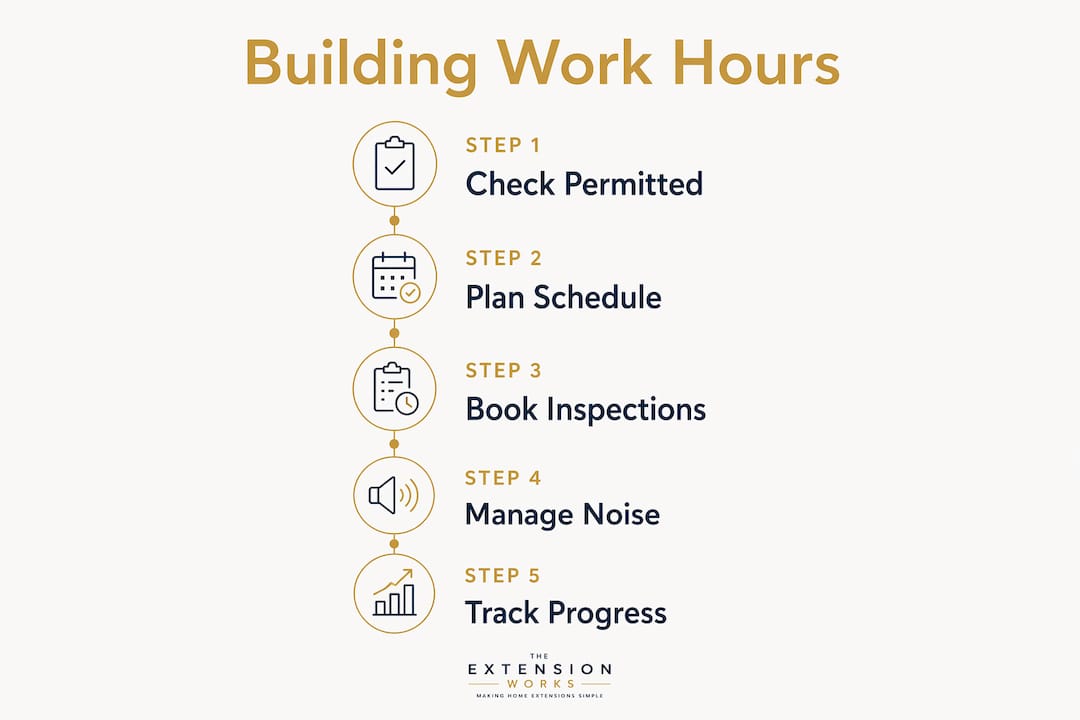
Permitting, inspection lag, and material procurement are the hidden phases that delay projects most. Homeowners typically focus on the physical build, but the time lost waiting for inspections or deliveries outside work hours compounds quickly. A single missed inspection can push a project back by days, not just hours.
The following factors most commonly extend construction project duration beyond initial estimates:
- Restricted daily windows. Ten hours per weekday sounds generous, but trades often overlap, and some tasks cannot run simultaneously.
- Inspection scheduling. Building control visits must fit within work hours, and inspectors book in advance. A missed slot adds days to the programme.
- Material delivery restrictions. Deliveries outside permitted hours are often refused by neighbours or blocked by council conditions. Ordering long-lead items early avoids this entirely.
- Crew availability. Dedicated full-time crews deliver projects faster and more reliably than part-time arrangements. A crew split across multiple sites cannot maximise your permitted hours.
- Weather and seasonal factors. Shorter daylight hours in winter reduce the effective working window even within permitted times.
Pro Tip: Map out every inspection point in your build programme before work starts. Book building control visits at least two weeks in advance to avoid gaps in the schedule.
Legal considerations and planning permissions for work hours
Planning permission often specifies working hours as legally binding conditions. These conditions can be more restrictive than the general council noise guidance. A planning condition might limit weekday work to 8:00 AM to 5:00 PM, for example, even if the borough’s standard guidance permits work until 6:00 PM.
Breaching a planning condition is a serious matter. Local authorities can issue stop notices, which halt all work immediately. Fines and enforcement action follow. The reputational damage to your contractor can also affect their willingness to continue the project.
Key legal points every homeowner should know before work begins:
- Check your planning portal. The London Borough of Sutton’s planning portal lists any project-specific hour conditions attached to your permission. These override general council guidance.
- The Control of Pollution Act 1974 applies regardless. Even if your planning permission is silent on hours, the Act gives the council power to restrict noisy work at any time.
- Neighbours can trigger enforcement. A single formal complaint can prompt a council inspection. Repeated complaints can lead to a Section 60 notice, which legally specifies when and how work must be carried out.
- Contractors carry the liability. Your builder is responsible for compliance, but as the homeowner, you can also be held accountable for nuisance caused by your project.
- Permitted development does not exempt you. Even projects built under permitted development rights must comply with noise and working hour restrictions.
Understanding these rules before you appoint a contractor puts you in a far stronger position. It also protects your relationship with neighbours, which matters long after the build is finished.
How to get more from your permitted building work hours
The most effective way to reduce your renovation timeline is to treat permitted hours as a finite resource and plan accordingly. Every hour lost to poor scheduling, late deliveries, or avoidable disputes is a direct cost to your project.
Early contractor involvement is the single biggest lever available to homeowners. Design-build project delivery reduces total timelines by 15% to 25% by overlapping design and permitting phases. That compression happens before a single brick is laid. The Extension Works operates on exactly this principle, managing design, planning, and construction as one coordinated process.
Practical steps that make a measurable difference:
- Order materials before work starts. Structural steel, roof lanterns, and bespoke glazing units carry lead times of four to eight weeks. Ordering on day one of planning approval, not day one of construction, keeps the build moving.
- Schedule noisy tasks early in the day. Demolition, drilling, and concrete work are best done in the morning when neighbours are less likely to be at home and when the team is at full energy.
- Communicate with neighbours in advance. A brief letter explaining the work schedule and your contractor’s contact details reduces complaints dramatically. Councils view proactive communication favourably if a dispute arises.
- Use BPM techniques throughout. Acoustic hoarding, water-fed cutting tools, and silenced generators all reduce noise levels. They also demonstrate good faith to the council and neighbours.
- Benchmark your timeline. Comparing your programme against industry standards helps identify unrealistic assumptions early. A single-storey rear extension in Sutton typically takes 10 to 16 weeks from groundworks to sign-off, depending on complexity.
Pro Tip: Ask The Extension Works for a week-by-week programme before contracts are signed. A written schedule makes it easy to spot gaps and hold the team accountable.
The Extension Works assigns a dedicated team to each project and manages the full process in-house. That structure means fewer handover delays between trades and better use of every permitted hour on site. You can see how this plays out in practice by browsing completed rear extensions from projects across London.
Key takeaways
Permitted building work hours are a fixed framework, but how you plan within them determines whether your extension finishes on time or runs over.
| Point | Details |
|---|---|
| Standard UK hours | Weekdays 8:00 AM to 6:00 PM, Saturdays 8:00 AM to 1:00 PM, no work on Sundays or Bank Holidays. |
| Local rules override national guidance | Always check the London Borough of Sutton’s planning portal for project-specific conditions. |
| Planning conditions are legally binding | Hour restrictions in your planning permission override general council noise guidance. |
| Early planning compresses timelines | Involving a design-build team before planning approval can reduce total project duration by 15% to 25%. |
| Non-build phases cause most delays | Permitting, inspections, and material procurement delay projects more than the physical construction itself. |
Why homeowners underestimate the value of work hour planning
Most homeowners I speak with treat building work hours as a minor administrative detail. They focus on the design, the budget, and the finish. The hours question gets answered with “the builder will sort it.” That assumption is where projects start to unravel.
The reality is that a ten-hour weekday window sounds generous until you account for a late delivery, a building control visit, and a neighbour complaint all landing on the same Tuesday. Suddenly you have lost half a day, and the programme slips. Multiply that across a twelve-week build and you are looking at a project that runs two to three weeks over with no obvious single cause.
What I have seen work consistently is treating the permitted hours as a production budget. You have a fixed number of hours available each week. Every decision, from when to schedule deliveries to which trades work in parallel, should be made with that budget in mind. The contractors who do this well finish on time. The ones who do not are always surprised when they do not.
The other misconception worth addressing is that Sunday restrictions are a minor inconvenience. For a project running close to a deadline, losing Sunday entirely is significant. The best teams plan around this from day one. They do not schedule tasks on a Friday that require Sunday follow-up to avoid a delay.
Viewing work hours as a framework rather than a restriction changes how you manage the whole project. It forces better planning, earlier material orders, and clearer communication with everyone involved.
— Esskay
Plan your extension with The Extension Works
Getting the hours right is one part of a well-run extension. The other parts, including design, planning permission, and construction management, need to work together from the start.

The Extension Works brings all of these together in one service for homeowners across London, including Sutton. You get a fixed VAT-inclusive price, a dedicated project team, and a 12-month workmanship warranty. The process starts with an instant online quote that gives you a real cost and time estimate without waiting weeks for a surveyor. From there, the team handles planning, design, and build in-house, so nothing falls through the gaps between contractors.
FAQ
What are the legal building work hours in the UK?
Standard permitted hours are 8:00 AM to 6:00 PM on weekdays and 8:00 AM to 1:00 PM on Saturdays, with no noisy work on Sundays or Bank Holidays. Local councils set their own rules under the Control of Pollution Act 1974, so always check with your specific borough.
Can planning permission restrict work hours further?
Yes. Planning conditions can specify hours that are more restrictive than general council guidance. These conditions are legally binding, and breaching them can result in a stop notice or enforcement action.
How do work hours affect how long a home extension takes?
Restricted daily windows reduce the hours available for noisy tasks each week. Combined with inspection scheduling and material delivery constraints, this means total project duration is often longer than the physical build time alone suggests.
What is Best Practicable Means in construction?
Best Practicable Means (BPM) is a legal requirement for builders to use effective noise mitigation techniques during permitted hours. It includes measures such as acoustic hoarding and quieter equipment, and councils use it as the standard when assessing noise complaints.
How can I shorten my extension timeline within permitted hours?
Involve your contractor early, order long-lead materials before work starts, and book building control inspections in advance. Early contractor involvement through a design-build approach can reduce total project timelines by 15% to 25%.
Recommended
- Permitted Development & Extension Rules 2026 — How Big Can You Build? | The Extension Works
- The Extension Works | Premium UK Rear Extensions
- Instant Extension Quote Tool — Design & Price Your Rear Extension Online | The Extension Works
- Extension Gallery — Real Rear Extensions, Before & After | The Extension Works