
Estimate vs quote: what's the real difference?
Discover the difference between estimate vs quote. Learn how to choose the right option to avoid unexpected costs and legal issues.

Estimate vs quote: what’s the real difference?
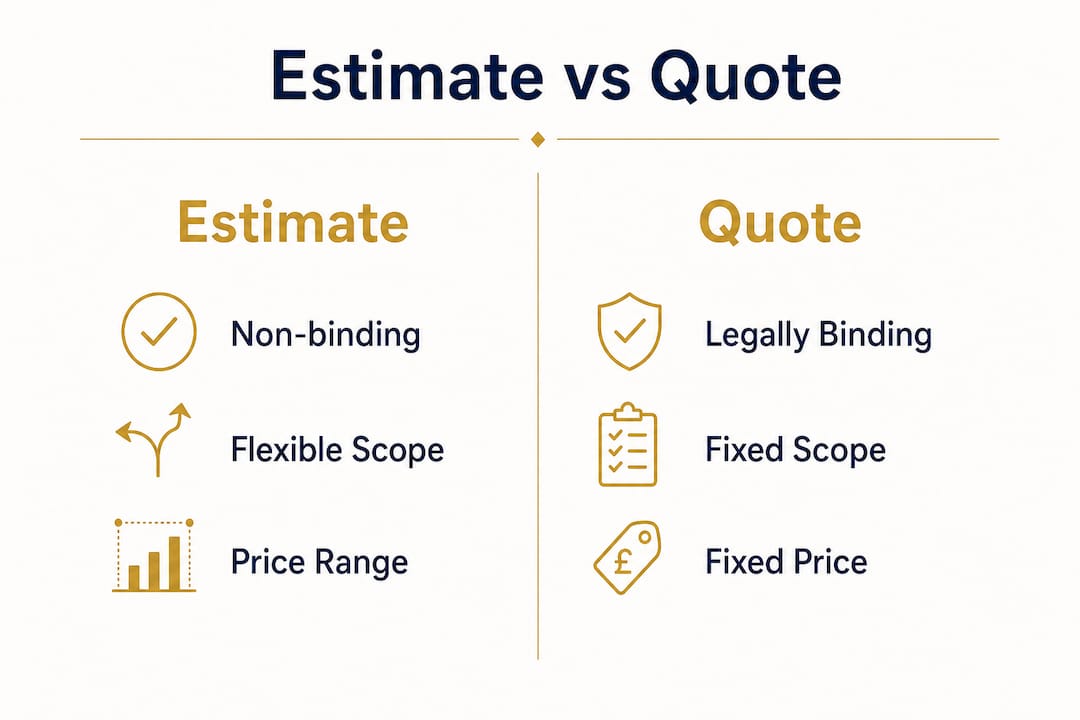
A quote is a fixed, legally binding price for a precisely defined scope of work, while an estimate is a non-binding approximation used for early budgeting and planning. Knowing the difference between an estimate vs quote is not a technicality. It determines who carries the financial risk when a project runs over budget. Confuse the two, and you can face unexpected costs, client disputes, or a legal commitment you never intended to make. This article explains both documents clearly, covers when to use each, and sets out the best practices that protect both clients and businesses.
What are the fundamental differences between an estimate and a quote?
The core distinction is legal status. A quote is a fixed price for a specified scope, and once a client accepts it, the provider is legally bound to deliver at that price. An estimate carries no such commitment. It is an informed approximation, useful for planning but subject to change as the project develops.
Binding status and price certainty
A quote locks in the price. If material costs rise after you issue a quote, that increase falls on the provider, not the client. An estimate shifts that risk the other way. Using an estimate transfers the cost overrun risk to the client, since the final invoice can legitimately differ from the figure given at the outset.

Price certainty also depends on how well the scope is defined. Quotes require a detailed, itemised breakdown of labour, materials, and any other costs. Estimates are often presented as ranges, acknowledging that unknowns exist. A builder quoting a loft conversion needs precise drawings and structural surveys. The same builder estimating a rear extension before planning permission is granted will work with approximations.
Scope definition and document features
Quotes demand a tight scope. Every deliverable, material specification, and exclusion should appear in writing. Accepted quotes act as binding agreements, so the scope definition is the primary legal defence against scope creep later. Estimates, by contrast, can be issued with broader assumptions and caveats, which is precisely what makes them useful at the early stages of a project.
| Feature | Quote | Estimate |
|---|---|---|
| Legal status | Binding once accepted | Non-binding |
| Price certainty | Fixed | Approximate range |
| Scope required | Fully defined | Broadly defined |
| Risk holder | Provider | Client |
| Typical use | Ready-to-proceed projects | Early budgeting and planning |
Pro Tip: Label every document explicitly as either “Formal Quote” or “Project Estimate.” Explicit labelling protects businesses by clarifying intent and reducing legal ambiguity from the start.
When should you use an estimate versus a quote?
The decision comes down to how much you know about the project at the time of pricing. A quote suits projects where the scope is clear and fixed. An estimate suits projects where variables remain unresolved.
Situations that call for an estimate
Estimates work best when the full scope cannot yet be confirmed. Common scenarios include:
- Early feasibility discussions where the client has not finalised the design
- Projects where material choices are still under review
- Renovation work where hidden structural issues may emerge once walls are opened
- Any situation where planning permission or surveys have not yet been completed
- Preliminary budgeting for financial planning or mortgage applications
In each case, the estimate gives the client a realistic cost range without locking the provider into a price that may prove unworkable once the full picture emerges.
Situations that call for a quote
Quotes are appropriate once the unknowns are resolved. If you have final drawings, confirmed materials, and a clear timeline, a quote is the right document. Clients prefer quotes for certainty, particularly in competitive situations where they are comparing multiple providers. A firm offer signals professionalism and commitment.
For homeowners in Morden planning a rear extension, for example, the process typically moves from an initial estimate during the design phase to a formal quote once the scope is confirmed and planning requirements are understood. The extension rules and permitted development rights that apply to a property directly affect the scope, so a quote issued before those are checked may not reflect the true cost.
Pro Tip: Always revisit an estimate before converting it to a quote. Firming up a quote after risks are reduced produces more accurate pricing and fewer disputes down the line.
What are the risks of getting estimates and quotes wrong?
Mislabelling is the most common and costly mistake. Mislabelling an estimate as a quote legally binds the provider to a price they never intended to commit to. That single error can turn a profitable project into a financial loss.
The risks of unclear documents
Clients who receive an estimate but treat it as a quote will expect the final invoice to match. When it does not, disputes follow. The provider then faces the uncomfortable task of explaining why the price has changed, often without any written protection. Transparent communication when issuing estimates prevents exactly this kind of conflict and helps maintain trust in variable scope projects.
Quotes carry their own risks. Issuing a binding quote before the scope is fully understood means absorbing any cost increases that arise. A quote on a kitchen extension that does not account for drainage rerouting, for instance, can quickly erode the margin on the entire job.
Best practices to protect yourself
- Include an expiry date on every quote and estimate. Expiry dates of 14–30 days are standard industry practice and protect against material cost fluctuations.
- State all assumptions clearly in estimates. Providing assumptions and warnings creates transparency and protects client trust.
- Define exclusions explicitly in quotes to prevent scope creep.
- Issue a new quote or formal change order whenever the scope changes after acceptance.
- Keep copies of all issued documents with timestamps for reference in any dispute.
Including detailed terms and expiry dates on both estimates and quotes, even when the estimate is non-binding, reduces future conflicts significantly.
How do estimates and quotes fit into proposals and contracts?
Estimates and quotes sit within a broader hierarchy of project documents. Understanding where each one belongs helps businesses choose the right document at the right stage.
A proposal is a more comprehensive document used for larger or more complex projects. Where a quote states a price for a defined scope, a proposal integrates the scope, pricing, methodology, timeline, and terms into a single document. Proposals are often valid for 30–90 days, reflecting the greater complexity and negotiation involved. Quotes typically carry shorter expiry periods because they are firm offers tied to current material and labour costs.
The document progression in practice
Most projects follow a natural sequence. An estimate is issued early, giving the client a cost range for budgeting. As the scope becomes clearer, the estimate is converted into a formal quote. For larger projects, a proposal may sit between the two, setting out the full commercial terms before a contract is signed.
The contract is the final document. It incorporates the accepted quote or proposal and adds legal protections for both parties, including payment schedules, dispute resolution clauses, and liability terms. Estimates never become contracts directly. They must first be firmed up into a quote, then accepted, before any contractual obligation exists.
| Document | Legal status | Typical validity | Primary purpose |
|---|---|---|---|
| Estimate | Non-binding | Open or short-term | Early budgeting |
| Quote | Binding on acceptance | 14–30 days | Fixed-price offer |
| Proposal | Negotiable | 30–90 days | Complex project offer |
| Contract | Fully binding | Project duration | Legal agreement |
Treating estimates as soft pipeline revenue is the correct financial approach. Outstanding estimates are not confirmed revenue until they are accepted and converted into quotes or contracts. Businesses that count estimates as booked work routinely overstate their forward order book.
Key takeaways
A quote is a legally binding commitment to a fixed price, while an estimate is a planning tool that carries no legal obligation until converted into a formal quote.
| Point | Details |
|---|---|
| Legal status differs | Quotes bind the provider on acceptance; estimates carry no legal obligation. |
| Risk allocation matters | Quotes place cost overrun risk on the provider; estimates place it on the client. |
| Label documents clearly | Mislabelling an estimate as a quote creates unintended legal and financial exposure. |
| Include expiry dates | Expiry periods of 14–30 days protect both parties from cost fluctuations. |
| Follow the document sequence | Projects typically move from estimate to quote to contract as scope is confirmed. |
Why clear pricing documents build better client relationships
The most common mistake I see businesses make is treating estimates and quotes as interchangeable. They are not, and the consequences of confusing them go beyond legal risk. They erode trust.
When a client receives a document labelled as a quote and the final bill is higher, they do not think “the scope changed.” They think they were misled. That perception, even when technically unfair, is the provider’s problem to manage. The fix is simple but requires discipline: issue estimates when you mean estimates, and quotes when you mean quotes.
I have also seen the opposite error. Providers issue estimates so cautiously worded that clients cannot use them for any meaningful budgeting. An estimate that says “costs could range from £20,000 to £80,000” is not useful to anyone. A good estimate is specific enough to be helpful and honest enough to reflect genuine uncertainty.
The best approach is to state your assumptions clearly, set a realistic range, and explain what would cause the price to change. That conversation, held early and in writing, prevents almost every dispute I have encountered. Professionalism in pricing documents is not about legal protection alone. It is about setting the right expectations from the first interaction.
— Esskay
Fixed-price quotes for your home extension with The Extension Works
Uncertainty in pricing is one of the biggest frustrations homeowners face when planning a rear extension. The Extension Works removes that uncertainty entirely.
The Extension Works provides an instant fixed-price quote for single-storey rear extensions, with a VAT-inclusive price generated online in minutes. There are no vague estimates to decipher and no surprise costs once work begins. Every quote covers design, planning, and construction managed by a dedicated in-house team, backed by a 12-month workmanship warranty. For homeowners in Morden ready to move from planning to building, The Extension Works offers the kind of pricing clarity this article has been making the case for.
FAQ
What is the main difference between an estimate and a quote?
A quote is a fixed, legally binding price for a defined scope of work. An estimate is a non-binding approximation used for early budgeting, and the final cost can differ from the figure given.
Is a quote legally binding?
Yes. Once a client accepts a quote, the provider is legally obligated to deliver the stated scope at the agreed price. Any changes to scope should be handled through a new quote or a formal change order.
When should I ask for a quote rather than an estimate?
Request a quote when the project scope is fully defined and you need a firm price commitment. Use an estimate when the scope is still being developed or when you need a cost range for initial budgeting.
How long is a quote valid for?
Most quotes carry an expiry period of 14–30 days, which is standard industry practice. This protects the provider against material and labour cost increases that occur after the quote is issued.
Can an estimate become a quote?
Yes. Projects often start with an estimate that is converted into a formal quote once the scope and costs are confirmed. The estimate should never be treated as a binding price until that conversion has taken place.