
Let The Extension Works handle skip permits for extensions in England
Know when a skip permit is needed in England, the seven working days' notice rule, safety requirements, and how The Extension Works takes care of permits...
Let The Extension Works handle skip permits for extensions in England
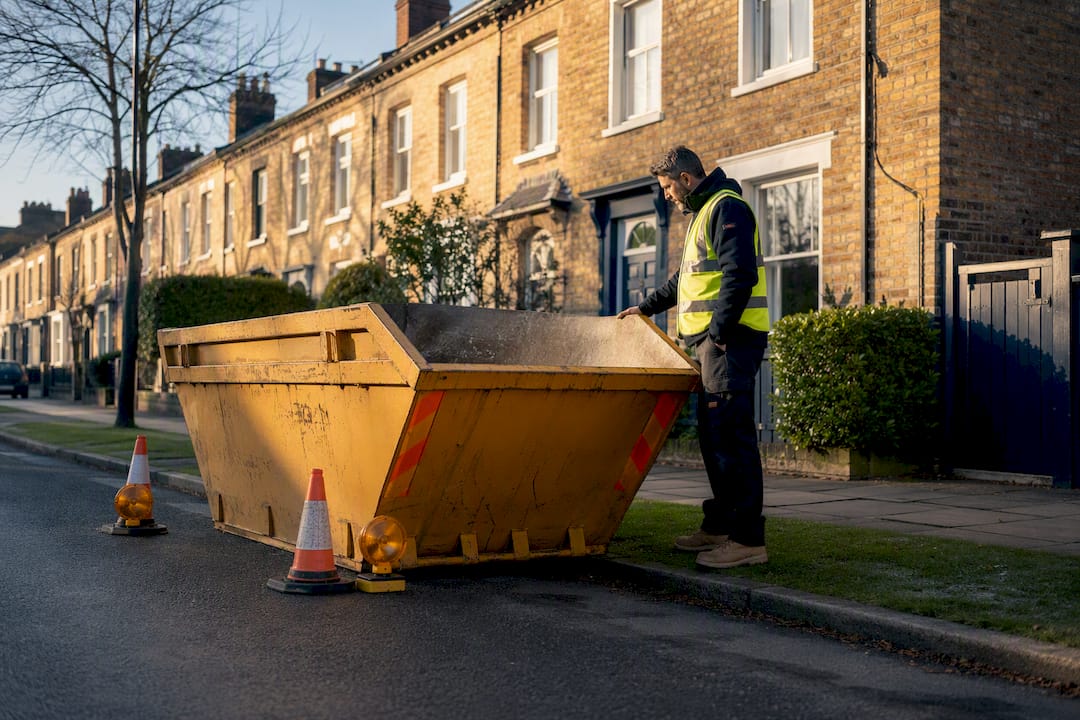
You need a skip permit if any part of the skip touches the public highway, whether that’s a road, pavement, verge, or parking bay. If the skip sits entirely on your own driveway or land, no permit is required. Check Gov or your local council’s application form before you book delivery.
TL;DR:
- A skip placed partly on public highway land, including verges and parking bays, always requires a permit, which can take at least seven working days to obtain.
- Councils enforce strict safety and marking conditions, such as reflective stripes, visible owner contact info, cones, and amber lights, which must be followed precisely.
- Placing a skip without a permit can result in removal, substantial fines, and additional charges for obstructing access or overfilling.
- Always verify the exact siting location and permit status beforehand, and get written confirmation of who applied for the permit and its costs.
- Using a wait-and-load service can eliminate permit requirements, but prices and availability vary, so plan accordingly to avoid delays.
Table of Contents
- When you need a skip permit for building work on the highway
- How to apply for a skip permit, and who’s responsible
- Safety, marking and where the skip can actually sit
- What happens if you skip the permit
- Your pre-delivery checklist
- How The Extension Works handles skip and permit logistics for you
- Get an instant quote and let permits become someone else’s problem
- Sources
When you need a skip permit for building work on the highway
The rule is simpler than most homeowners expect, but the definition of “public highway” catches people out constantly. It doesn’t just mean the tarmac road itself. Legally, it covers pavements, grass verges, parking bays, and any adopted highway land, even the bit of pavement you assumed was part of your property boundary.
Get this wrong and you’re looking at an unlicensed skip sitting on council land, which brings fines and forced removal into play. GOV.UK’s guidance on skip licences is unambiguous: if any part of the skip overhangs or touches that public land, a licence is mandatory.
Here’s how that plays out in practice for a typical rear extension project:
- A skip parked entirely on your driveway, wholly inside your boundary, needs no permit at all.
- A skip that overhangs the pavement by even a few inches, or sits partly on a verge, triggers the permit requirement.
- Suspending a residential parking bay to fit a skip always requires council permission, since the bay itself is highway land.
- Private estate roads and shared car parks sit in a grey area. Some are technically private, but if they’re maintained by a management company or classed as adopted, you may still need permission from whoever controls that land.
If you’re unsure which category your driveway falls into, a quick call to the council’s highways team settles it in minutes. It’s far cheaper than an argument after delivery.
How to apply for a skip permit, and who’s responsible
Applying isn’t complicated, but it does need lead time. Most council forms ask for the same core details, and building this into your project schedule avoids delays.
- Site location and dates. You’ll state the exact address, the proposed siting (kerb side, outside number X), and start and end dates for the skip’s stay.
- Number of skips and size. Some projects need two or three skips over several weeks; the council wants to know upfront.
- Description of work. A brief note on what’s generating the waste, useful context for enforcement officers checking compliance.
- Contact details for the responsible party. This is where liability gets decided, so read it carefully.
Bedford Borough Council’s skip licence application form is a useful example of what to expect: it asks for all of the above and typically requires at least seven working days’ notice before delivery.
Pro Tip: Skip operators often say “we’ll sort the permit,” but you remain legally liable if it’s placed unlawfully. Get written confirmation of exactly who submitted the application, and keep a copy of the permit number.
Fees vary enormously by council. Rent-a-Skip’s permit fee checker shows most councils charging somewhere in the a moderate fee range for a standard permit, with central London boroughs often charging considerably more. Somerset Council, for instance, publishes permit periods commonly running from about a week to nearly a month, with extension charges applying if you overrun. If your project timeline is tight or your delivery is urgent, ask your supplier about a wait-and-load service instead. The lorry waits while the skip is filled, then leaves on the same visit, so it never actually sits on the highway and no permit is needed. Check how much skip size for extension work you’ll actually need before committing to a duration, since undersizing means a second delivery and a second permit fee.
Safety, marking and where the skip can actually sit
Once your permit is granted, the council attaches conditions, and they’re not optional extras. These stem from the Builders’ Skip Marking Regulations 1984 and the Highways Act 1980, section 139, which together set out what a lawfully placed skip must look like.
- Reflective markings or stripes on all sides, visible from a reasonable distance.
- The skip owner or operator’s name and contact number displayed clearly.
- Cones and traffic signage around the skip during daylight hours.
- Amber lamps fitted at night, lit from dusk until dawn for the entire permit period.
- Siting with the longer side parallel to the kerb, a short distance from it, approximately aligned with typical council guidelines, never blocking drains or manhole covers.
Councils will refuse footway placement except in genuinely exceptional cases, so don’t assume a pavement spot is a fallback option.
Pro Tip: Ask your skip operator to send a photo of the skip once it’s sited, with lamps and cones visible. It takes thirty seconds and gives you evidence the placement was compliant if a neighbour or warden ever queries it.
What happens if you skip the permit
Placing a skip on the highway without a licence is an offence under the Highways Act, and councils don’t treat it as a minor administrative slip. They can remove the skip and bill you for the cost, on top of any fine.
GOV.UK confirms that fines for non-compliance, whether that’s no permit at all or missing safety markings, can be substantial, potentially reaching a significant amount. Common triggers for extra surcharges or refused collection include:
- Obstructing pedestrian access or a dropped kerb.
- Blocking a drain, manhole, or emergency access route.
- Overfilling the skip above the rim.
- Mixing hazardous or controlled waste into general building rubble.
If a permit application is refused, or an existing one gets revoked mid-project, contact the council’s highways team immediately rather than leaving the skip in place. Early communication almost always gets a faster resolution than waiting for an enforcement notice to land.
Your pre-delivery checklist
Run through this before the lorry arrives, not after:
- Confirm exactly where the skip will sit relative to your boundary line, and whether that placement needs a permit.
- If it does, get the permit number in hand before delivery day, not promised for “sometime this week”.
- Ask your supplier to confirm in writing who applied for the permit, and check the fee is included in your quote rather than added later.
- Request proof of the operator’s insurance and accreditation, plus a photo of the intended siting.
- Plan your collection date, any likely extension, and notify neighbours if a parking bay is being suspended.
How The Extension Works handles skip and permit logistics for you
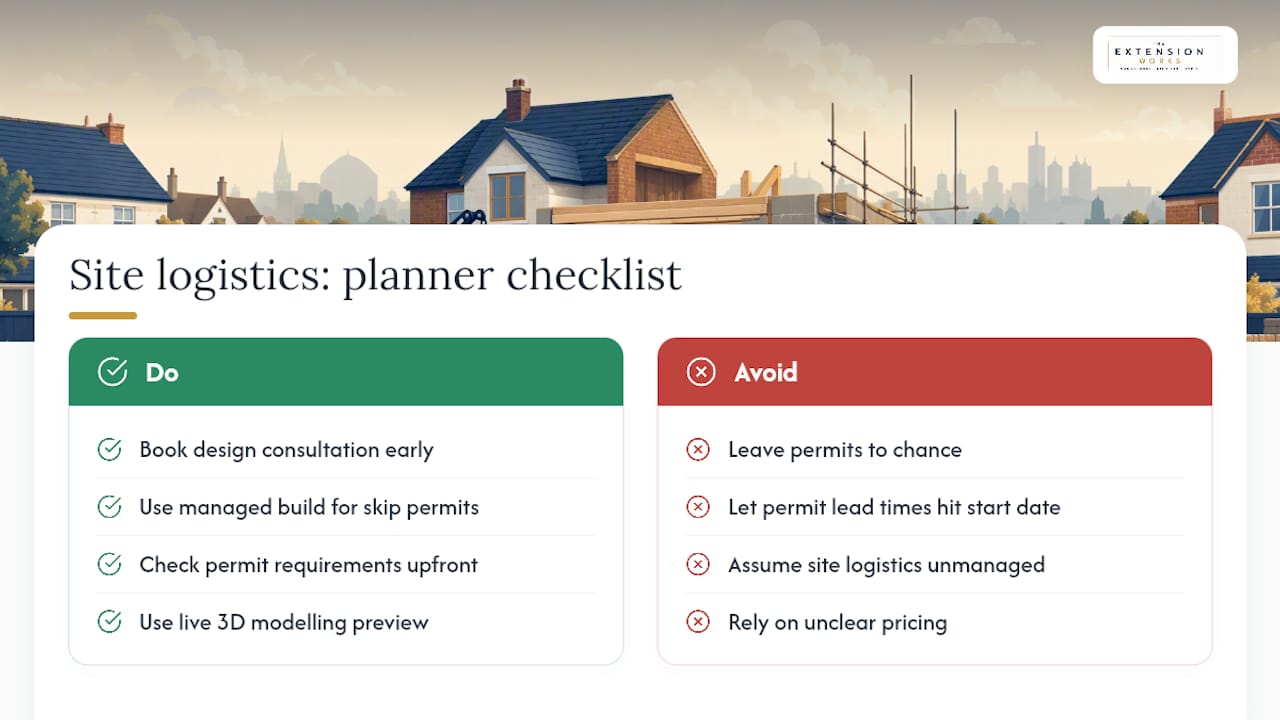
Skip permits are exactly the kind of detail that derails an otherwise well-planned extension, and understanding the separate requirements of building regulations is one of the things The Extension Works builds into project coordination rather than leaving to chance. Site logistics, including skip placement and permit checks, get handled as part of the managed build.
That sits alongside the wider service: an instant quote tool, live 3D modelling so you can see the extension before a brick is laid, fixed VAT-inclusive pricing, and a 12-month workmanship warranty. If you’re planning a rear extension, book a design consultation early enough that permit lead times never touch your start date.
Get an instant quote and let permits become someone else’s problem
Chasing a council for a skip licence while also managing an architect, a builder, and a planning application is exactly the kind of admin that turns a straightforward extension into a stressful one. The Extension Works folds that logistics work into the build itself: when you book through the Instant Extension Quote tool, site coordination, including skip placement and permit checks, is handled by your dedicated project team rather than left for you to sort between builder phone calls.

You get a fixed, VAT-inclusive price from the outset, live 3D modelling so you can see the finished space before work starts, and a 12-month workmanship warranty backing the build. Browse the full range of services covering design, planning, and construction in one place, then start your instant quote to see what a permit-free (for you, at least) extension project actually looks like.
Sources
- Gov
- Skip Licence Application Form 2026 (Bedford)
- Skip permit checker | Rent-a-Skip
- Apply for skip licence - Somerset Council