
Planning application timeline: your 2026 guide
Navigate the planning application timeline effectively. Understand phases, deadlines, and ensure a smoother process for your property request.

Planning application timeline: your 2026 guide
A planning application timeline is the structured sequence of statutory phases and deadlines that governs how your Local Planning Authority (LPA) processes and decides on a property extension request. For most householder extensions, the statutory decision target is 8 weeks for minor applications and 13 weeks for major developments. That clock does not start on the day you submit your paperwork. It starts only once your council validates your application as complete. Factor in design preparation, validation, and public consultation, and the realistic total duration from first sketch to decision sits at 3–6 months. Understanding each phase puts you in control of that timeline rather than at its mercy.
What are the stages of the planning application process?
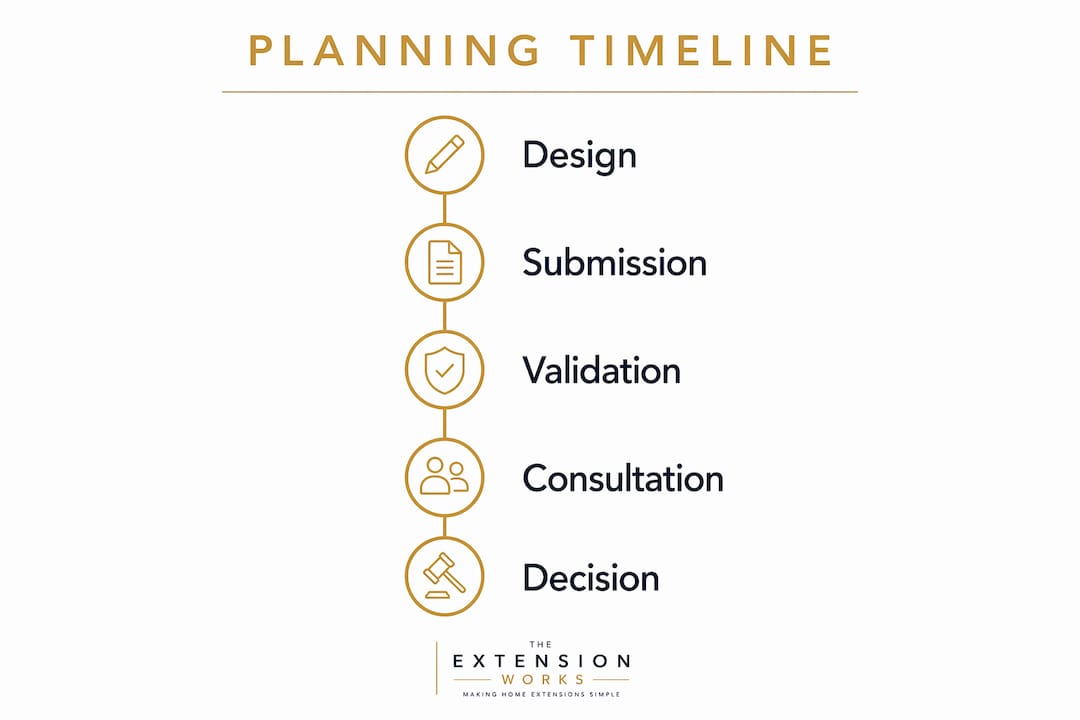
The planning application process breaks into five distinct phases, each with its own typical duration. Knowing what happens in each phase stops you from misreading silence as progress or progress as a guarantee.
Design and preparation: 4–8 weeks
This phase covers everything before you submit. You need measured drawings, a design and access statement, a site location plan, and any supporting documents your LPA requires. Rushing this stage is the single most common cause of delays later. Spending 4–8 weeks here to get the drawings right saves weeks of back-and-forth after submission.

Submission and validation: 1–3 weeks
Submission is not the same as validation. Validation is distinct from submission; the statutory clock starts only after your council confirms all required documentation and fees are properly received. If documents are missing, the clock never starts. An incomplete submission can cause indefinite delays before the statutory period even begins.
Public consultation: 21 days
The public consultation period is fixed at 21 days and runs in parallel with the officer’s assessment. Neighbours, statutory consultees such as highways and drainage bodies, and the general public can submit comments during this window. The consultation does not pause the officer’s work, but significant objections can trigger additional rounds of assessment.
Officer assessment and decision: up to 8 or 13 weeks
The planning officer reviews your proposal against the Local Plan and the National Planning Policy Framework (NPPF). Minor householder applications carry an 8-week target; major developments carry a 13-week target; applications requiring an Environmental Impact Assessment can extend to 16 weeks. These are targets, not guarantees. Committee referrals, specialist consultee responses, and requests for further information all push the decision date back.
| Application type | Statutory target | Typical total duration |
|---|---|---|
| Householder extension | 8 weeks | 3–4 months |
| Minor commercial | 8 weeks | 3–5 months |
| Major development | 13 weeks | 5–8 months |
| EIA-required | 16 weeks | 8–12 months |
Pro Tip: Submit a complete, well-prepared application from day one. Every missing document resets the validation clock and adds weeks before the statutory period even begins.
How do statutory deadlines and planning guarantees affect your application?
Statutory deadlines exist to protect applicants from indefinite delays. The government’s planning guarantee policy sets the 8, 13, and 16-week targets as formal performance benchmarks for LPAs. Missing these targets does not automatically mean your application is refused. It means you gain the right to appeal for non-determination, which is the right to treat the absence of a decision as a refusal and take your case to the Planning Inspectorate.
In practice, most applicants do not exercise that right immediately. Extensions of time are commonly requested by LPAs, and applicants typically agree rather than appeal non-determination. The reason is pragmatic: refusing an extension of time can strain your relationship with the planning officer and sometimes leads to longer overall delays.
Key facts about statutory deadlines and your options:
- The 8-week target applies to householder and minor applications; 13 weeks applies to major applications; 16 weeks applies to EIA applications.
- If your LPA misses its target, you can appeal for non-determination to the Planning Inspectorate.
- The Planning Inspectorate aims to reach appeal decisions within 26 weeks.
- Agreeing to an extension of time preserves goodwill and keeps the process moving.
- Planning permissions remain valid for 3 years once granted, giving you time to organise construction.
Pro Tip: If your LPA requests an extension of time, ask for a written explanation and a revised decision date. This keeps the process transparent and gives you a clear record if you later need to appeal.
What common factors cause planning application delays?
Delays in the planning application process almost always trace back to one of three sources: poor submission quality, local policy conflicts, or neighbour objections that trigger specialist consultee involvement.
Applications frequently exceed statutory deadlines due to poor quality plans, failure to address local planning policies like the NPPF, or missing documents. Each of these issues sends the application back to the applicant for correction, which pauses progress entirely.
Neighbour objections are a common source of anxiety, but their impact depends on their content. Planning officers assess proposals objectively based on the Local Plan and NPPF, ignoring non-material objections such as loss of private view or property devaluation. Objections based on loss of light, privacy, or highway safety carry weight. Objections based on personal preference do not.
Pre-application discussions with your LPA, though optional, are one of the most effective ways to identify policy conflicts before they become refusals. Investing 2–8 weeks in pre-app advice costs between £50–£500 but can save months of delay by surfacing objections early and improving the quality of your submission.
The most common delay triggers are:
- Incomplete or inaccurate drawings that fail validation.
- Missing supporting documents such as a design and access statement or drainage assessment.
- Proposals that conflict with the Local Plan or NPPF without adequate justification.
- Specialist consultee responses from bodies such as highways, ecology, or heritage teams.
- Neighbour objections that require additional officer assessment.
Pro Tip: Engage a professional designer or planning consultant before submission. Their familiarity with local policy and validation requirements reduces the risk of avoidable delays significantly.
For Bracknell homeowners, the Bracknell Forest Council Local Plan sets specific design and amenity standards that your application must address directly. Aligning your drawings with those standards from the outset is far more effective than responding to objections after submission.
How long do appeals take and what are the deadlines?
If your application is refused, you have the right to appeal to the Planning Inspectorate. The appeal deadline depends on your application type. The appeal deadline is 12 weeks for householder and minor commercial applications, and 6 months for most other planning appeals. Enforcement notice appeals carry a compressed 28-day deadline, which requires immediate action.
The duration of the appeal itself varies by procedure:
- Written representations are the most common route for householder cases. Appeals by written representations typically take 4–6 months.
- Hearings involve a structured discussion with an inspector and add several months to that timeline.
- Public inquiries are reserved for complex or major cases and can take a year or more.
| Appeal type | Deadline to appeal | Typical duration |
|---|---|---|
| Householder written representations | 12 weeks from refusal | 4–6 months |
| Minor commercial written representations | 12 weeks from refusal | 4–6 months |
| Major application appeal | 6 months from refusal | 6–12 months |
| Enforcement notice appeal | 28 days from notice | Variable |
Success rates for householder appeals sit at around 33–40%. Professional support for an appeal typically costs £2,000–£10,000. Before committing to an appeal, weigh the cost and time against the option of revising and resubmitting a stronger application.
What practical steps can homeowners take to manage the timeline?
Managing the planning permission timeline well is less about speed and more about preparation. Every week you invest before submission saves two or three weeks of delay after it.
- Start with a clear, feasible design brief. Know what you want to build before engaging anyone. A vague brief produces vague drawings, which produce validation failures.
- Check your permitted development rights first. Many single-storey rear extensions qualify under permitted development rules and require no full planning application at all. This can cut months from your timeline.
- Book a pre-application consultation with your LPA. Pre-app advice identifies policy conflicts early. The cost of pre-app advice is £50–£500, which is modest compared to the cost of a refused application.
- Prepare a complete submission from day one. Use your LPA’s validation checklist. Every document on that list must be present and correct before you submit.
- Maintain contact with your planning officer during assessment. A brief, professional email at the four-week mark asking for an update is entirely appropriate. It signals engagement without applying pressure.
- Respond promptly to information requests. If your officer requests additional information, a slow response pauses the process entirely. Treat every request as urgent.
- Understand committee referral risk. Applications with significant objections or policy complexity may be referred to a planning committee rather than decided by an officer. Committee meetings follow a fixed schedule, which can add 4–8 weeks to your timeline.
The end-to-end timeline for a typical home extension project, from initial design through to decision, runs 3–6 months. Planning for that duration from the outset avoids the frustration of expecting a faster result.
Key takeaways
The planning application timeline for a householder extension runs 3–6 months in total, and the statutory 8-week decision clock starts only after your LPA validates your submission as complete.
| Point | Details |
|---|---|
| Statutory decision targets | 8 weeks for minor applications, 13 weeks for major, 16 weeks for EIA-required cases. |
| Validation starts the clock | Submit every required document correctly the first time to avoid indefinite pre-clock delays. |
| Pre-application advice saves time | Spending £50–£500 on pre-app discussions can prevent months of delay from policy conflicts. |
| Appeals carry strict deadlines | Householder appeals must be lodged within 12 weeks of refusal; enforcement appeals within 28 days. |
| Permitted development is faster | Many rear extensions qualify under permitted development rights and bypass the full application process. |
Why patience and preparation matter more than speed
Most homeowners I speak with expect the planning process to behave like an online transaction. Submit the form, wait eight weeks, get the answer. The reality is more nuanced, and understanding that nuance is what separates applicants who sail through from those who spend months in limbo.
The planning officer is not your advocate and not your opponent. Officers apply a plan-led system, meaning their decisions follow the Local Plan and the NPPF, not personal judgement. Many applicants misunderstand this and spend energy trying to persuade officers rather than aligning their proposals with policy. That energy is almost always wasted.
Pre-application engagement is the single most underused tool available to homeowners. I have seen applicants skip it to save time, only to receive a refusal six months later on grounds that a 30-minute pre-app conversation would have surfaced immediately. The optional nature of pre-app advice leads people to treat it as unnecessary. It is not.
One more thing worth saying plainly: do not dispute minor validation issues. If your LPA asks for a corrected site plan or an additional supporting document, provide it without argument. Contesting validation requirements delays the process and achieves nothing. The statutory clock cannot start until validation is complete, and no amount of correspondence changes that.
The applicants who manage the planning application process well share one trait. They treat planning as a structured process requiring preparation, not a bureaucratic obstacle to be rushed. That mindset, combined with professional support for drawings and submission, produces the best outcomes.
— Esskay
Planning your extension with The Extension Works
Getting the design right before you submit is the most effective way to keep your application on track. The Extension Works combines design, planning support, and construction into one managed service for single-storey rear extensions, removing the guesswork from the preparation phase.
The Instant Extension Quote Tool lets you design and price your rear extension online in minutes, with live 3D modelling and a fixed VAT-inclusive price. Every project comes with a dedicated team and a 12-month workmanship warranty, covering the process from initial drawings through to final sign-off. For Bracknell homeowners ready to move from planning to building, The Extension Works offers a clear, managed route to a finished extension without the usual delays.
FAQ
How long does a planning application take in the UK?
The total duration for a householder extension application typically runs 3–6 months, covering design, validation, public consultation, and the 8-week statutory decision period.
When does the 8-week planning clock start?
The statutory 8-week period begins only after your LPA validates your application as complete. Submitting incomplete documents means the clock never starts until all required materials are received and confirmed.
What happens if my LPA misses the 8-week deadline?
You gain the right to appeal for non-determination to the Planning Inspectorate. Most applicants instead agree to an extension of time to preserve goodwill with the planning officer.
How long do I have to appeal a refused planning application?
The appeal deadline is 12 weeks from the date of refusal for householder applications, and 6 months for most other planning appeals. Enforcement notice appeals must be lodged within 28 days.
Can I avoid a full planning application for a rear extension?
Many single-storey rear extensions qualify under permitted development rights and do not require a full planning application. Check the current extension rules for your property type and size before submitting anything to your LPA.