
Planning permission timeline: what UK homeowners need to know
Discover the planning permission timeline for UK homeowners. Understand every step from design to decision and plan your project effectively!

Planning permission timeline: what UK homeowners need to know
Plan for Multiple months end-to-end on a typical householder project, not just the 8-week statutory target the council is set. The decision clock only starts after formal validation, and design, drawings, consultation and officer assessment all consume time before and around that window.
Key numbers to hold in mind:
- Design and drawings: 4–Around two months
- Validation: 1–3 weeks (longer if your submission is incomplete)
- Public consultation: About three weeks, running concurrently with officer assessment
- Statutory decision target: Approximately two months for most householder and minor applications; Several months for major developments
- Realistic decision period in practice: 8–Up to about three months or more
- Typical end-to-end for a householder extension: Multiple months
For a more detailed breakdown of each phase, the planning application timeline guide from The Extension Works walks through every stage.
Table of Contents
- What are the stages of the planning permission timeline?
- What do the statutory decision periods actually mean?
- What commonly causes delays beyond the statutory period?
- How can you shorten the planning permission wait time?
- What do realistic timelines look like for different projects?
- What should you do if the council misses its deadline?
- How do timescales differ across the UK nations?
- Key takeaways
- The part most homeowners underestimate
- How The Extension Works can help with your planning timeline
- Useful sources
What are the stages of the planning permission timeline?
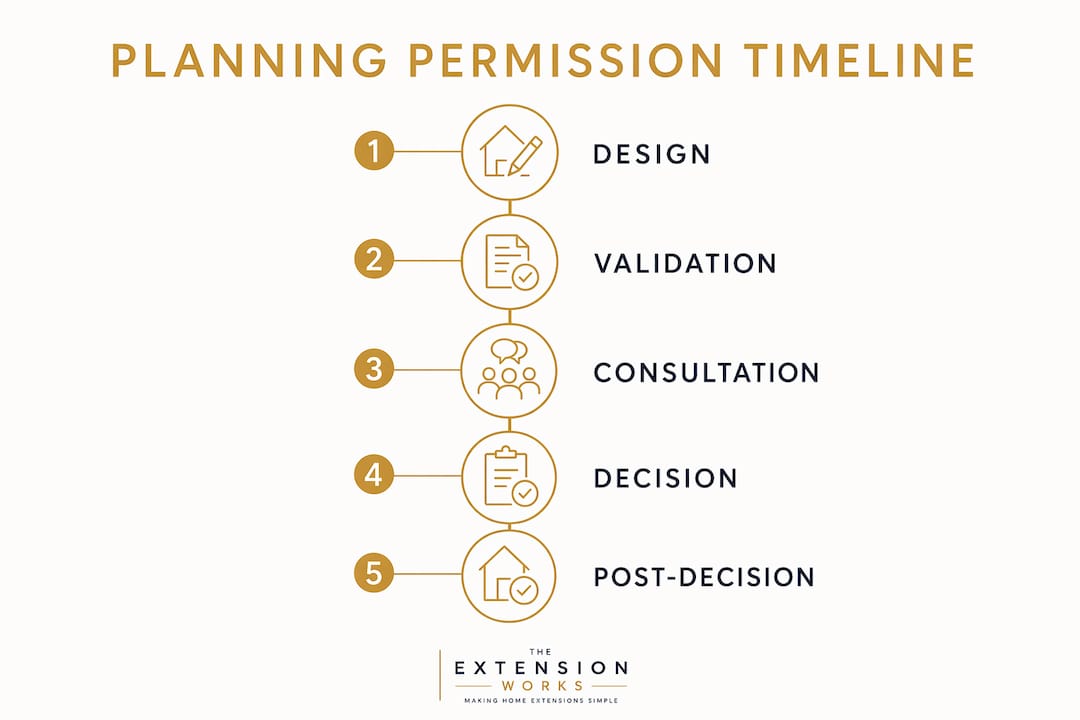
The process has six distinct phases, and understanding where each one sits helps you spot where time is actually lost.
- Preparation and design. Your architect or designer produces drawings, a site plan, and any supporting documents. For a domestic extension this typically takes 4–Around two months. Getting planning permission drawings right first time is the single biggest factor in a smooth validation.
- Pre-application advice (optional). Many local planning authorities (LPAs) offer a paid pre-application service. It adds a few weeks upfront but can prevent a refusal or a costly redesign later, particularly on constrained sites.
- Submission and validation. You submit via the Planning Portal. The council checks your application for completeness before formally registering it. Validation typically takes 1–3 weeks for a complete submission; an incomplete one can stall for several more weeks before the clock even starts.
- Publicity and consultation. Once validated, the council notifies neighbours and statutory consultees. They have About three weeks to respond. This period usually runs in parallel with the officer’s initial assessment.
- Officer assessment and site visit. The case officer reviews policy compliance, visits the site, and considers all consultation responses. For straightforward proposals, James Garrett of the Planning Portal notes that a decision can come in under eight weeks once validated, but only when there are no complicating consultee responses.
- Decision. Most householder applications are decided under delegated powers by the officer. Larger, more complex, or controversial proposals go to a planning committee, which adds a further Several weeks to the cycle. The decision notice is then issued and published.
What do the statutory decision periods actually mean?
GOV.UK sets out three main statutory targets under the Town and Country Planning (Development Management Procedure) (England) Order 2015:
- Around two months for most householder and minor applications.
- Several months for major developments.
- Several months where an Environmental Impact Assessment is required.
The clock starts at formal validation, not the day you submit. That distinction matters: applicants frequently underestimate the pre-validation period and therefore the true project lead time.
If an LPA misses its statutory target without a written extension agreement, the government’s planning guarantee applies. Under that policy, non-major applications should be decided within Several months and major applications within Up to about half a year. No application should spend more than a year with decision-makers, including any appeal.
Where more time is genuinely needed, the LPA and applicant can agree an extension in writing. That written agreement pauses the statutory deadline and is standard practice when further information or negotiation is required. It is not a failure of the process; it is a normal tool.
Stat to remember: the planning guarantee caps non-major applications at Several months and major ones at Up to about half a year — but the statutory target remains 8 or Several months respectively.
What commonly causes delays beyond the statutory period?
The 8-week target is widely quoted, but since 2020 many LPAs have faced reduced budgets, staff turnover and higher application volumes, according to planning consultant Simon Rix. The result: many applications run to 8–Up to about three months or longer even for straightforward proposals.
Specific causes and the time they typically add:
- Incomplete submissions: validation delays of 1–4 weeks before the clock starts.
- Consultation objections or statutory consultee responses: Additional weeks of officer time to address.
- Committee referral: an extra Several weeks for the committee cycle.
- Specialist reports required mid-process (ecology, heritage, highways): variable, but commonly Several weeks.
- LPA resourcing and backlogs: Multiple weeks of slippage, particularly in busy urban authorities.
- Amendments during determination: any significant change can reset or pause the timetable; a written extension agreement is usually needed.
How can you shorten the planning permission wait time?
Preparation is where most time is saved or lost. A validation-proof submission is the single most effective action you can take.
- Confirm whether your project needs full planning permission or qualifies under permitted development rules before you spend money on drawings.
- Prepare complete drawings, a clear site location plan (at 1:1250 scale), and any required supporting statements before submission.
- Check for heritage designations, protected trees, or ecological constraints early. Discovering these after submission is a common cause of mid-process delays.
- Request pre-application advice from your LPA if the site is constrained or the proposal is borderline. The upfront cost is usually recovered in time saved.
- Respond promptly to any officer or consultee queries. Delays in returning information are one of the most controllable causes of slippage.
- Engage neighbours before you submit. A neighbour who understands the proposal is far less likely to object formally.
Pro Tip: Using an integrated design-to-build service, where architects, planners and builders work from the same brief, removes the handover gaps that typically add weeks between design sign-off and a validated submission.
What do realistic timelines look like for different projects?

| Scenario | Best case | Typical | Worst case |
|---|---|---|---|
| Householder rear extension (full planning) | Around 10 weeks | Between several and many weeks | Over several months |
| Larger residential / full application | Several months | Several months | Many months |
| Permitted development / prior approval | Several weeks | 8–Around 10 weeks | Up to about three months (statutory cap) |
Scenario A — small householder extension. Design takes Several weeks; validation 1–2 weeks; consultation and officer decision 8–Around 10 weeks. Best case: around Around 10 weeks total. Add a committee referral and you are looking at 5–6 months.
Scenario B — larger residential full application. Consultant inputs (heritage, highways, ecology) add 4–8 weeks to preparation. Committee risk is higher. Budget 6–9 months as a realistic planning-to-decision window.
Scenario C — permitted development / prior approval. Prior approval routes carry a statutory cap of a statutory cap period of several weeks for certain categories. If the council does not respond within that period, permission is deemed granted. This makes permitted development the fastest route when your project qualifies. Check the rear extension planning guide for size limits and eligibility.
Tasks overlap: design and pre-application advice run in parallel; consultation and officer assessment overlap; building control booking can begin before the decision notice arrives.
What should you do if the council misses its deadline?
- Check your validation date. The statutory clock runs from that date, not your submission date.
- Contact the case officer. Ask for a progress update and a realistic decision date.
- Request a written extension agreement if the officer needs more time. This is preferable to a deemed refusal and preserves the working relationship.
- Appeal for non-determination. Once the statutory period has passed without a decision (and no extension has been agreed), you have the right to appeal to the Secretary of State. Written representation appeals typically take 4–6 months; hearings and inquiries take longer.
- Request a fee refund. If your non-major application remains undetermined after Several months (or Up to about half a year for major), and no extended period was agreed, GOV.UK confirms the application fee must be refunded.
How do timescales differ across the UK nations?
The statutory targets above apply in England. The devolved nations operate similar frameworks but with local variations.
- Wales: The Planning (Wales) Act 2015 introduced a broadly comparable system. The Welsh Government’s Planning Portal (Planning Permission Wales) is the primary reference.
- Scotland: Handled under the Town and Country Planning (Scotland) Act 1997. Statutory targets are set by Scottish Ministers; check your local authority’s development management pages.
- Northern Ireland: Administered by the Department for Infrastructure and local councils. Decision periods differ from England; check nidirect.gov.uk for current timescales.
For any project outside England, always verify the current statutory periods with the relevant national planning authority rather than relying on England-specific guidance.
Key takeaways
Most householder planning applications in England take Multiple months from design to decision, with the statutory 8-week target applying only to the post-validation decision period.
| Point | Details |
|---|---|
| Statutory decision target | Around two months for householder/minor; Several months for major; clock starts at validation. |
| Realistic end-to-end | Most householder extensions take Multiple months including design, validation and decision. |
| Planning guarantee | Non-major applications must be decided within Several months; major within Up to about half a year. |
| Fastest route | Prior approval / permitted development carries a 42-day statutory cap for eligible projects. |
| The Extension Works | Offers in-house design, planning and build with validation checks included, reducing handover delays for Morden homeowners. |
The part most homeowners underestimate
The Short statutory decision period is not wrong, but it is only part of the story. What catches people out is the pre-validation period: drawings that need revising, a site plan at the wrong scale, a missing heritage statement. None of that time counts toward the statutory clock, yet it can easily add a month or more before the council even registers your application.
The second thing people underestimate is committee risk. A proposal that attracts three or more objections, or sits in a conservation area, is far more likely to be referred to committee. That adds Several weeks and introduces a degree of political unpredictability that no amount of preparation fully removes. If your project has any of those characteristics, factor it into your programme from day one.
The practical implication: treat planning as a 3–6 month budget line, not an 8-week formality. Projects that plan for the realistic timeline rarely fall behind; projects that plan for the statutory minimum almost always do.
How The Extension Works can help with your planning timeline
Waiting months for a planning decision is frustrating enough without also chasing three separate firms for drawings, structural calculations and a build quote. The Extension Works handles the entire process in-house: instant online quote, architectural pack, validation checks, project management, and construction, all under one fixed VAT-inclusive price with a 12-month workmanship warranty.
For Morden homeowners, that means fewer handovers, a single point of contact for consultee queries, and a team that knows what local planning officers expect in a submission. The result is a validation-proof application prepared from the outset, which is the most reliable way to avoid the 1–4 week delays that incomplete submissions routinely cause.
Get an instant quote and see your rear extension design in live 3D before committing to anything.
Useful sources
- Determining a planning application — GOV.UK: statutory time limits, planning guarantee, extension agreements and fee refund rules for England.
- Planning Portal: submit applications, check validation requirements and track application status.
- How long does planning permission take? — Homebuilding: practical commentary on LPA backlogs and realistic timescales.
- How long does planning permission take? — WhatCanIBuild: end-to-end timeline breakdown including validation and prior approval caps.
- Planning application timeline guide — The Extension Works: stage-by-stage guide for domestic extension projects.
- Renovation waste management guide — Local Skip Bin Hire: practical logistics for coordinating trades once planning is granted.
- Your local authority’s planning pages: search “[your council] planning application timescales” for authority-specific targets and validation checklists.
Recommended
- Planning permission drawings: a homeowner’s 2026 guide — The Extension Works
- Planning application timeline: your 2026 guide — The Extension Works
- Permitted Development & Extension Rules 2026 — How Big Can You Build? | The Extension Works
- Rear extension planning: UK rules and local guide 2026 — The Extension Works