
Remortgage for extension: what UK homeowners need to know
Discover how to remortgage for extension to finance your home renovation. Learn loan requirements and explore your options!

Remortgage for extension: what UK homeowners need to know
Yes, you can remortgage to fund a home extension, and it is one of the most common ways UK homeowners finance structural building work. Lenders treat it as standard capital raising, so approval comes down to two things: whether the new total mortgage stays within their loan-to-value limit, and whether the monthly repayments are demonstrably affordable against your income.
- LTV ceiling: Most lenders advance up to most of the property’s value in total mortgage, including additional borrowing. Your current equity determines how much headroom you have. Your current equity determines how much headroom you have.
- Affordability test: Lenders stress-test your income against the new monthly payment. You will need payslips, bank statements, and evidence of outgoings.
- When alternatives are worth considering: A further advance from your existing lender, a personal loan, or equity release may suit better depending on project size, age, and how much equity you hold.
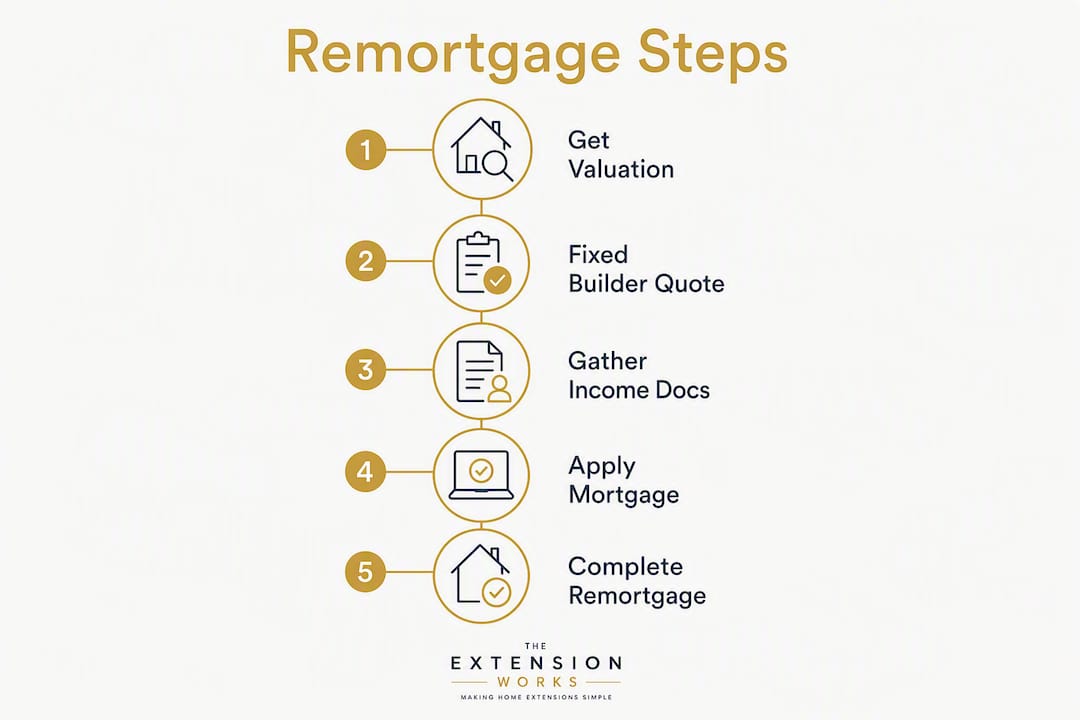
Get an up-to-date valuation, a fixed builder quote, and your income evidence ready before you apply.
Table of Contents
- How does a cash-out remortgage work for an extension?
- How much can you realistically borrow for an extension?
- When should you remortgage: before, during, or after the build?
- What will lenders check, and what documents do you need?
- What costs should you budget for when remortgaging?
- What are the alternatives to remortgaging?
- Step-by-step checklist to prepare your remortgage application
- Common mistakes to avoid when remortgaging for an extension
- Should you use a broker or apply direct?
- Key takeaways
- The case for planning your finance and your build together
- Ready to get a fixed quote that supports your remortgage application?
- Useful sources for further reading
How does a cash-out remortgage work for an extension?
When you remortgage for an extension, you are either switching to a new lender for a larger amount than your current balance, or increasing the borrowing with your existing lender. The difference between the new loan and what you owe goes to you as cash, secured against the property.

Remortgage proceeds are secured against your home and repaid under mortgage terms, which typically means a lower interest rate than an unsecured personal loan for the same sum. The trade-off is that your home is at risk if repayments stop, and the debt runs over a longer term.
How it differs from other borrowing:
- Further advance: Extra borrowing from your existing lender, often faster and with fewer fees, but limited to that lender’s products.
- Second-charge mortgage: A separate loan secured against the property alongside your existing mortgage; useful when your current deal has high early repayment charges.
- Personal loan: Unsecured, faster to arrange, but higher rates and shorter terms.
Worked example: Your home is worth £400,000. You owe £200,000. At 85% LTV, the maximum total mortgage is £340,000, giving you up to £140,000 of additional borrowing (subject to affordability). If you need £80,000 for a rear extension, the new mortgage balance would be £280,000. At a hypothetical rate of 4.5% over 25 years, the monthly payment on the full £280,000 would be around £1,540, compared with roughly £1,100 on the original £200,000.
How much can you realistically borrow for an extension?
The maximum is set by three variables: your property’s current value, your outstanding mortgage balance, and your household income. Lenders will not simply take your word on value; they commission their own valuation.
LTV in plain terms: If your home is worth £350,000 and a lender caps at 85% LTV, the maximum total mortgage is £297,500. Subtract your existing £180,000 balance and you can borrow up to £117,500 more, before affordability is tested.
An up-to-date valuation is essential before applying, because the figure the lender uses is their surveyor’s number, not an estate agent’s estimate. Some lenders will consider a projected post-completion value, but most base their decision on the current value.
The critical point: plan around realistic lender LTV ceilings rather than an assumed valuation uplift from the finished extension. Lenders value the property as it stands today.
When should you remortgage: before, during, or after the build?
Timing matters more than most homeowners expect, and each option carries a different risk profile.
Before works begin
- Pros: Funds are available when the builder starts; no cash-flow gap; lender values the property at its current state.
- Cons: Mortgage offer validity (typically six months) may expire if the build overruns; you are paying interest on the full sum before work is complete.
During the build
- Pros: You can use savings or a bridging loan to start, then remortgage once works are underway.
- Cons: Lenders may be cautious about a property mid-construction; valuation can be complicated.
After completion
- Pros: The finished extension may support a higher valuation, potentially improving your LTV position.
- Cons: You need funds to pay the builder before the remortgage completes, which usually means bridging finance or savings.
Pro Tip: Check your planning permission timeline before locking in a mortgage offer. A standard planning application takes eight weeks; if approval arrives late, your offer window may be tighter than you think. Permitted development works avoid this delay entirely.
Remortgaging involves application, valuation and legal processes that commonly take several weeks and may incur early repayment charges if you leave a fixed-rate deal early. Factor that into your build schedule.
What will lenders check, and what documents do you need?
Lenders treat a remortgage for home improvement as standard underwriting. There is no special category; the checks are the same as any remortgage.
Affordability and credit checks:
- Last three months’ payslips (or two years’ tax calculations if self-employed)
- Bank statements showing income and regular outgoings
- Credit report (check yours via Experian or Equifax before applying)
- Stress-tested repayment at a higher notional rate
Property and works checks:
- Current mortgage statement and title details
- Description of planned works and estimated cost
- Planning permission or permitted development confirmation where relevant; many lenders accept permitted development works without formal planning, but larger structural changes may trigger additional requests
- Building regulations compliance plan (required for structural work)
Pro Tip: A fixed, itemised builder quote is more useful than a ballpark figure. Lenders want to see that the costs are real and verifiable. The Extension Works produces a fixed VAT-inclusive quote with a project brief that lenders can assess directly, which removes one of the most common causes of underwriting delays.
Independent brokers can confirm lender-specific documentation requirements before you apply, saving you from submitting to a lender whose criteria your project does not meet.
What costs should you budget for when remortgaging?
The fees add up quickly, and for smaller projects they can make remortgaging uneconomic.
| Fee type | Typical range |
|---|---|
| Early repayment charge | 1–5% of outstanding balance |
Set-up fees are often substantial enough that remortgaging may be inefficient for smaller projects. For smaller sums, a further advance or personal loan often works out cheaper once fees are factored in.
On top of mortgage fees, budget for the build itself. VAT at 20% applies to most building work on existing residential properties. And a contingency of 15–20% over the quoted project cost is standard advice for structural works. For a rear extension costing £80,000, that means holding back £12,000–£16,000 for overruns before you start.
What are the alternatives to remortgaging?
- Further advance: Extra borrowing from your current lender on your existing mortgage. Faster and cheaper than a full remortgage; best when your current rate is competitive and the project is under £50,000.
- Second-charge mortgage: A separate secured loan that sits behind your existing mortgage. Useful when early repayment charges make switching lenders expensive.
- Unsecured personal loan: No property security required; faster to arrange but rates are higher and terms shorter, typically up to seven years.
- Bridging loan: Short-term, high-cost finance used to cover the gap between starting works and completing a remortgage. Only appropriate as a temporary measure.
- Equity release (lifetime mortgage): Typically for homeowners aged 55 and over; no monthly repayments required, but the debt compounds and is repaid on sale, death, or entry into long-term care. It affects inheritance and may affect means-tested benefits.
For a drain survey or site investigation that some lenders or local authorities request as part of larger extensions, a specialist guide such as this drain survey for extension resource covers what to expect.
Step-by-step checklist to prepare your remortgage application
- Get a current valuation (1–2 weeks): commission an independent RICS valuation to establish your equity position before approaching lenders.
- Obtain a fixed builder quote (1–2 weeks, can run in parallel): a detailed, itemised quote with VAT shown separately is what lenders and surveyors need.
- Confirm planning status (up to 8 weeks if full planning is needed; permitted development is immediate): check whether your extension falls within permitted development rules or requires a formal application.
- Check your credit report (1–3 days): resolve any errors before a lender runs a hard search.
- Gather income evidence (1 week): payslips, P60, bank statements, or self-assessment tax calculations.
- Speak to an independent broker (1–2 weeks): model the maximum borrowing and identify lenders whose criteria match your project.
- Submit the application (1–2 weeks to process): lender instructs valuation and legal work.
- Receive mortgage offer (2–4 weeks from application): review conditions carefully, particularly any works-related conditions.
- Complete and release funds (1–2 weeks): legal completion; funds released to you or direct to builder as agreed.
Total timeline: allow 8–14 weeks from starting the process to funds in hand.
Common mistakes to avoid when remortgaging for an extension
- Under-quoting project costs: A quote that does not include VAT, groundworks, or structural engineering will leave you short. Always request a fully itemised, VAT-inclusive figure.
- Ignoring the contingency: Skipping the 15–20% reserve is the single most common cause of mid-build financial stress.
- Not checking early repayment charges: Leaving a fixed-rate deal early can cost thousands. Calculate the ERC before assuming a remortgage is cheaper than a further advance.
- Overstretching affordability: Borrowing to the maximum LTV leaves no buffer if rates rise or income changes. Stress-test your own budget, not just the lender’s.
- Relying on an assumed valuation uplift: Extensions add value, but lenders value the property as it stands. Do not borrow against a number that does not yet exist.
If you spot any of these red flags, pause before applying. Get an independent builder quote, speak to a broker, and confirm financing before works start. For complex cases — mixed-use property, unusual title, or significant structural change — take specialist legal and mortgage advice.
Should you use a broker or apply direct?
For a straightforward remortgage with a mainstream lender, applying direct is perfectly viable. But for extension funding, a broker usually earns their fee.
Questions to ask any broker or lender:
- What is the maximum LTV you will lend to, and how do you treat projected post-completion value?
- What documentation do you require for extension works: builder quote, planning permission, building regulations?
- Are there any restrictions on the type of works (e.g. structural, basement, or mixed-use)?
- What are the total fees, and is the arrangement fee added to the loan or paid upfront?
Pro Tip: Choose a broker who is independent (not tied to a panel), holds a CeMAP qualification, is FCA-regulated, and publishes a transparent fee schedule upfront. A broker who charges a flat fee rather than a percentage of the loan is usually better value on larger borrowing.
Independent brokers access a broad range of lenders and can model your maximum available borrowing across multiple criteria before you commit to an application. That matters when lender policies on extension funding vary as much as they do.
Key takeaways
A remortgage for an extension is approved or declined on two factors above everything else: your current LTV position and whether the new repayment is affordable against your verified income.
| Point | Details |
|---|---|
| LTV and affordability decide approval | Most lenders cap total borrowing at 85–90% LTV; affordability is stress-tested against your income. |
| Get a valuation and fixed quote first | Lenders use their own surveyor’s figure, not an estate agent’s estimate; a fixed builder quote reduces underwriting friction. |
| Budget for fees and contingency | Total set-up fees typically run £1,800–£3,500; add a 15–20% contingency on top of the build cost. |
| Consider alternatives for smaller projects | Projects under £50,000 are often cheaper to fund via a further advance or personal loan due to the typical remortgage set-up fees. |
| The Extension Works simplifies the evidence | Fixed VAT-inclusive quotes and planning documentation from The Extension Works give lenders exactly what they need to approve additional borrowing. |
The case for planning your finance and your build together
The conventional advice is to sort your finance first, then find a builder. That sequence makes sense on paper, but it misses something: lenders want to see a credible, costed project before they approve additional borrowing, and most builders will not produce a detailed fixed quote until they know the project is real.
The result is a circular problem that delays applications by weeks. The homeowners who move fastest are those who treat the builder quote and the mortgage application as parallel tracks, not sequential ones. A fixed, VAT-inclusive quote with a clear project scope is not just useful for your budget; it is the document that makes a lender’s valuer confident the works are real and the costs are verifiable.
There is also a tendency to over-engineer the finance decision. Homeowners spend months comparing rates and LTV thresholds when the more pressing question is whether the project scope is defined clearly enough for any lender to assess. Get the scope right first. The finance follows.
Ready to get a fixed quote that supports your remortgage application?
The biggest friction point in a remortgage for an extension is producing documentation that lenders will actually accept. Ballpark estimates and verbal agreements do not pass underwriting. What lenders want is a fixed, itemised cost with VAT shown, a clear description of the works, and confirmation of planning status.

The Extension Works provides exactly that: an instant online quote with fixed VAT-inclusive pricing, live 3D modelling so you can see the finished extension before committing, and a project team that handles planning permission or permitted development confirmation in-house. Every quote comes with the documentation a lender’s valuer needs to assess the works with confidence. There are no long waits for estimates and no ambiguity about what is included. See completed projects in the gallery and then get your fixed quote online today.
Useful sources for further reading
- Unbiased: how to release equity for home improvements — clear guide to equity release options including lifetime mortgages for homeowners aged 55+
- Pepper Money: can I remortgage to build an extension? — lender perspective on valuation, equity and affordability
- Legal & General: equity release and remortgage for home improvements — covers timing, exit fees and the remortgage process
- NatWest: additional borrowing for home improvements — mainstream lender guidance on remortgaging to renovate
- Fox Davidson: how to finance a house extension in 2026 — broker perspective on financing routes for different project sizes
Recommended
- Planning permission timeline: what UK homeowners need to know — The Extension Works
- Rear extension cost in 2026: a UK homeowner’s guide — The Extension Works
- Rear extension cost London: 2026 guide for homeowners — The Extension Works
- Home insurance renovation: what you need to know — The Extension Works