
VAT on extensions: what UK homeowners need to know
Discover essential insights on VAT on extensions for UK homeowners. Understand the rates that apply and budget accordingly for your project.

VAT on extensions: what UK homeowners need to know
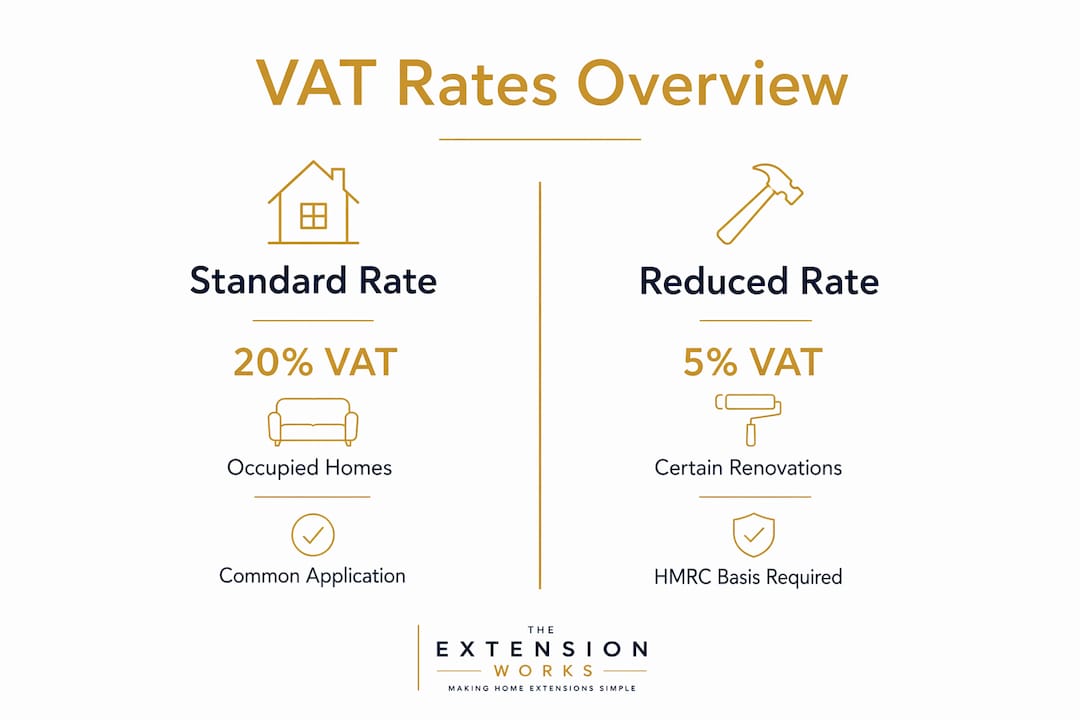
Most home extensions are charged at the standard 20% VAT rate under HMRC’s VAT Notice 708. That means an extension becomes 20% more expensive once VAT is added. There are narrow exceptions at 5% and 0%, but they do not apply to a typical occupied home. Budget for 20% unless your builder can show you a documented HMRC basis for anything lower. The Extension Works publishes fixed VAT-inclusive prices, so the number you see is the number you pay.
Table of Contents
- Which VAT rates apply to your extension?
- When can the 5% reduced rate apply to building work?
- Does zero-rating ever apply to an extension?
- How VAT is applied to labour, materials and contractor invoices
- Can you reclaim VAT on a home extension?
- What to ask your builder before signing anything
- The Extension Works: fixed VAT-inclusive pricing for Bracknell homeowners
- Key takeaways
- Why the VAT rules on extensions are less complicated than they look
- Fixed VAT-inclusive quotes from The Extension Works
- Primary sources and further reading
Which VAT rates apply to your extension?
Three rates exist under UK law, and only one applies to most homeowners.
- 20% standard rate: applies to all extensions, refurbishments and maintenance on an occupied dwelling, unless a specific HMRC relief applies.
- 5% reduced rate: available only in narrowly defined circumstances set out in VAT Notice 708 (empty homes, conversions, changed dwelling count).
- 0% zero rate: reserved for the construction of a wholly new dwelling or an enlargement that creates one.
| VAT rate | When it applies | Example: net cost |
|---|---|---|
| 20% standard | Occupied home extension | Net cost plus 20% VAT |
| 5% reduced | Empty home, conversion | Net cost plus 5% VAT |
| 0% zero | New dwelling within enlargement | Net cost plus 0% VAT |
One further point worth knowing: builders whose taxable turnover falls below the VAT registration threshold do not charge VAT at all. Most established firms exceed that threshold, so you should always ask. A VAT-inclusive fixed quote removes the uncertainty entirely.
When can the 5% reduced rate apply to building work?
The short answer: rarely, and only when HMRC’s specific tests are met. The 5% reduced rate covers three situations.
- Renovating an empty home. The dwelling must have been unoccupied for the two years immediately before work starts. Council tax records or utility disconnection dates are the evidence HMRC expects to see.
- Converting a non-residential building into a dwelling. A barn, office or church becoming a home can qualify; an existing house being extended cannot.
- Changing the number of dwellings. Splitting one house into two flats, or merging two flats into one, can attract the reduced rate on qualifying work.
The critical distinction: the 5% rate is charged by the builder at the point of supply. Zero-rating on a later sale or disposal is a separate relief entirely. Conflating the two is one of the most common errors homeowners and their advisers make.
Pro Tip: If a builder quotes 5% on a straightforward extension to your occupied home, ask them to put the HMRC basis in writing before you sign anything. Misapplying the reduced rate is a compliance risk that can result in retrospective assessments.
Does zero-rating ever apply to an extension?
Occasionally, but the conditions are strict. Under VAT Notice 708, zero-rating can apply to an enlargement where the new dwelling sits wholly within that enlargement. The key word is “wholly.” If any part of the new dwelling occupies existing floor space, the zero-rating does not apply to the whole project.
HMRC’s test in plain terms: the new dwelling must be entirely contained within the new structure being built. A flat built above a rear extension may qualify; an annexe that shares walls or services with the main house typically does not.
Practical cases where this comes up:
- A self-contained flat built entirely within a new extension, with its own entrance, kitchen and bathroom.
- A new dwelling created above a garage extension, wholly within the new build volume.
What it does not cover:
- An annexe connected to the main house.
- An extension that enlarges an existing dwelling without creating a separate unit.
- Any arrangement where the new dwelling partially occupies the original building.
Documentation matters here. You will need architectural drawings showing the new dwelling is wholly within the enlargement, plus a written declaration from the builder confirming the zero-rating basis.
How VAT is applied to labour, materials and contractor invoices
A VAT-registered builder charges VAT on the full value of their supply, which covers both labour and materials. The two are not separated for VAT purposes on a standard design-and-build contract.
For a larger project, the maths scales directly. A £80,000 rear extension carries £16,000 in VAT, bringing the total to £96,000. That is not a rounding error; it is a meaningful budget line.
Subcontractors add a layer worth understanding. Your main contractor pays VAT on subcontractor invoices and recovers it through their own VAT return. You see only the main contractor’s invoice. Building control fees from the local authority may also carry VAT depending on the charging authority; Bracknell Forest’s building control charge schedule itemises fees accordingly, so check the schedule when budgeting.
Pro Tip: Ask your builder for a proforma invoice before work starts. It should show the net amount, the VAT rate applied, the VAT amount, and the gross total. Any vague description like “works as agreed” without a VAT rate stated is a red flag.
Can you reclaim VAT on a home extension?
For most owner-occupiers, the honest answer is no.
The rule of thumb: if you live in the property and you are not VAT-registered, you cannot reclaim the VAT your builder charges on a standard extension. It is a cost, not a recoverable tax.
There are limited routes where reclaim or refund is possible.
| Route | Who qualifies | Conditions |
|---|---|---|
| DIY Housebuilder scheme | Individuals building a new home | New build or qualifying conversion only; standard extensions excluded |
| VAT-registered landlord | Business with taxable rental income | Only where the extension is used for a taxable business purpose |
| Developer converting to residential | Person carrying out a qualifying conversion | Must make a zero-rated first grant (sale or long lease) of the converted dwelling |

The DIY Housebuilder scheme is the most commonly misunderstood. It covers new builds and some conversions, but it does not extend to a standard rear extension on an occupied home. Recordkeeping for any legitimate claim requires original VAT invoices, planning permission documents, and evidence of the qualifying condition (empty home period, conversion type).
What to ask your builder before signing anything
Getting VAT treatment confirmed in writing before work starts costs nothing. Discovering a dispute afterwards costs a great deal.
- Is your firm VAT-registered? Ask for their VAT registration number and verify it on the HMRC online checker.
- What VAT rate are you charging, and on which elements? Standard rate on everything, or a reduced rate on specific parts?
- What is the HMRC basis for any rate below 20%? Ask them to cite the specific section of VAT Notice 708.
- Will the invoice show the VAT rate, VAT amount, and gross total separately? This is a legal requirement on a VAT invoice.
- Are any subcontractors or suppliers billing you separately? If so, will those costs appear on your invoice inclusive of VAT?
Red flags to watch for: a builder who claims zero-rating on a standard occupied-home extension; vague invoice descriptions with no VAT rate stated; reluctance to put the VAT treatment in writing.
Sample wording to request on the contract or invoice: “Works charged at [X]% VAT under [section X] of HMRC VAT Notice 708. Supporting documentation held on file.”
The Extension Works: fixed VAT-inclusive pricing for Bracknell homeowners
The Extension Works publishes fixed VAT-inclusive prices. The figure shown in your instant online quote is the total you pay, with no VAT added at invoice stage.
| Feature | What The Extension Works offers |
|---|---|
| Pricing transparency | Fixed VAT-inclusive price from the first quote |
| Quote method | Instant online tool with live 3D modelling |
| Project delivery | In-house design, planning and build team |
| Warranty | 12-month workmanship warranty |
| Planning | Permitted Development and prior-approval handled in-house |
For Bracknell homeowners, that means the extension project management process, from architectural drawings through to building control sign-off, sits with one team under one fixed price. Before contracting with any provider, ask for a written VAT breakdown confirming the inclusive basis and check that their VAT registration number appears on the quote.
Key takeaways
Most home extensions are standard-rated at 20% VAT, and owner-occupiers cannot reclaim it, so the only reliable way to avoid budget surprises is to get a fixed VAT-inclusive quote in writing before work starts.
| Point | Details |
|---|---|
| Standard rate is 20% | Budget 20% VAT on top of any net quote unless a documented HMRC relief applies. |
| 5% applies in narrow cases only | Empty homes (2+ years unoccupied), non-residential conversions, and changed dwelling counts only. |
| Owner-occupiers cannot reclaim VAT | The DIY Housebuilder scheme covers new builds and some conversions, not standard extensions. |
| Get VAT treatment in writing | Ask for the HMRC basis, the VAT rate, and a compliant invoice before signing any contract. |
| The Extension Works quotes VAT-inclusive | Fixed VAT-inclusive pricing from the instant quote tool removes the most common source of budget confusion. |
Why the VAT rules on extensions are less complicated than they look
The guidance around VAT on building work runs to dozens of pages in Notice 708, and tax advisers make a living from the edge cases. But for the vast majority of Bracknell homeowners planning a rear extension, the picture is genuinely simple: it is 20%, full stop.
The confusion tends to come from two places. First, people hear about the 5% reduced rate and assume it might apply to them. It almost certainly does not, unless the property has sat empty for two years or you are converting a non-residential building. Second, some builders, usually smaller ones operating below the VAT threshold, do not charge VAT at all, which can make their quotes look artificially competitive. Always check VAT registration before comparing prices.
The one piece of advice worth repeating: do not wait until the invoice arrives to ask about VAT. A builder who cannot tell you their VAT registration number and the rate they intend to charge before work starts is not a builder you want managing a six-figure project. Get it in writing, check it against Notice 708, and if anything looks unusual, a quick call to an accountant costs far less than a retrospective HMRC assessment.
Fixed VAT-inclusive quotes from The Extension Works
Budgeting for a rear extension is hard enough without a VAT bill arriving as a surprise at the end. The Extension Works gives Bracknell homeowners a fixed, VAT-inclusive price from the first moment, generated instantly through an online quote tool that includes live 3D modelling of your specific project.

Every project is managed in-house, from architectural drawings and planning permission through to the final build, under a single fixed price and a 12-month workmanship warranty. There are no separate subcontractor invoices to reconcile and no VAT surprises at handover. Use the instant quote tool to get your fixed VAT-inclusive price today.
Primary sources and further reading
- HMRC VAT Notice 708: Buildings and construction — the definitive HMRC guidance on VAT rates for building work, including the standard rate, reduced rate conditions and zero-rating rules. Check this first for any complex scenario.
- HMRC: VAT refunds for DIY housebuilders — official guidance on the DIY Housebuilder scheme, eligibility conditions and how to make a claim.
- HMRC: VAT registration — use the HMRC checker to verify a builder’s VAT registration number before signing a contract.
- The Extension Works — fixed VAT-inclusive pricing, instant online quoting and in-house design and build for single-storey rear extensions in Bracknell and surrounding areas.
This article is general information, not professional tax advice. For your specific circumstances, verify current rules with HMRC or a qualified tax adviser.