
Get a Fixed Price Rear Extension in England and Avoid Provisional Sums
How provisional sums work in England for single storey rear extensions, and how a fixed price or clearer contracts avoid unexpected bills.

Get a Fixed Price Rear Extension in England and Avoid Provisional Sums
A provisional sum is an allowance built into your contract price for work that cannot be properly designed, measured or priced when the contract is signed. It is not a fixed cost. Once the actual work is known, the allowance is removed from the contract sum and replaced with the real cost, which can push your final bill up or down. For homeowners, the practical lesson is simple: any figure labelled “provisional” is a placeholder, not a promise.
TL;DR:
- Clearly distinguish between defined and undefined provisional sums, as only the latter pose higher risks of claims for additional costs and delays.
- Always obtain written confirmation from your contractor specifying whether each provisional sum is defined or undefined before signing the contract.
- Keep detailed records of all instructions, quotes, and variations related to provisional sums, and monitor them through a project register to prevent disputes.
- Limit provisional sums in your contract to reduce uncertainty and push for comprehensive site investigations and design resolution beforehand.
- Understand that provisional sums are contractual allowances based on specific wording, not statutory rules, making careful review of contract clauses essential.
Table of Contents
- What is a provisional sum?
- Defined or undefined: why the label changes who carries the risk
- How provisional sums get valued and adjusted
- Provisional sums vs prime cost items vs contingency
- Common pitfalls and how to avoid disputes
- Tracking and closing out provisional sums
- Provisional sums on a rear extension: what you’ll actually see
- How The Extension Works handles provisional sums
- What the law says about provisional sums
- How provisional sums affect your project timeline
- Provisional sums under JCT and NEC contracts
- Get a fixed-price rear extension quote
- The editorial take: why fewer provisional sums beats better management of them
- Sources
What is a provisional sum?
A provisional sum is a specific figure written into a building contract to cover work that the designer or quantity surveyor cannot yet detail, quantify or price accurately. According to the Designing Buildings Wiki, it functions as a contractual mechanism that lets a project start before every element of the design is finished. Without it, contracts on anything but the simplest jobs would grind to a halt while every last detail gets resolved on paper.
The term carries no statutory definition. LexisNexis confirms that a provisional sum is a matter of contract drafting, not law. Its meaning and effect depend entirely on the wording of the specific contract you sign, whether that is a JCT, NEC, or a bespoke agreement drawn up by a smaller builder.
Provisional sums typically appear where:
- Ground conditions are unknown until excavation starts
- A specialist package (say, a kitchen or bathroom fit) has not been designed in detail
- Statutory approvals or utility company decisions are still pending
- The client has not yet chosen a fitting, finish, or system
That’s the entire mechanism in one sentence, and it is worth remembering because most disputes trace back to someone forgetting this swap has to happen properly, with evidence, rather than by informal agreement on site.
Defined or undefined: why the label changes who carries the risk
Not all provisional sums are equal. UK contract practice splits them into two categories, and which one applies to your project changes who absorb the risk of surprises.
A defined provisional sum gives the contractor enough information to price and programme the work sensibly. That typically means the contract states:
- The nature and scope of the work
- Approximate quantities
- The likely location within the building
- Any known limitations on method or access
Because the contractor has that detail, Designing Buildings notes they are deemed to have made due allowance for it in their programme and preliminaries. If the work turns out heavier than expected, the contractor has less room to claim extra time or overhead costs, since they already priced for the risk.
An undefined provisional sum lacks that detail. The contractor cannot reasonably allow for it in their programme, so if the work materialises, they are generally entitled to claim additional time and preliminaries on top of the actual cost. This is where JCT and NEC contracts diverge in their mechanics, but the underlying principle holds across both: the less information you give the contractor up front, the more contractual room they have to claim disruption later.
Pro Tip: Ask your contractor to state, in writing, whether each provisional sum in your contract is defined or undefined before you sign. It takes five minutes and it settles a question that otherwise surfaces mid-project, usually at the worst time.
How provisional sums get valued and adjusted
Turning an estimate into a final figure follows a fairly consistent sequence, whether you’re on a JCT Minor Works contract for a rear extension or a larger NEC framework.
- Instruction. The contract administrator, architect, or main contractor formally instructs the provisional-sum work. This should be in writing, dated, and specific about scope. Verbal instructions on site are the single biggest source of later disputes.
- Pricing. The contractor prices the actual work, either against rates already fixed in the contract, via a formal quotation, or on a cost-plus basis if nothing else was agreed.
- Valuation. The provisional sum is omitted from the contract sum in full, and the priced work is added back in. LexisNexis notes that RICS and JCT valuation rules govern how work “of similar character” to items already in the contract should be priced, versus work with no comparable rate.
- Adjustment. The contract sum is revised up or down, and the change flows into interim valuations and eventually the final account.
Contract administrators will typically want documentary evidence before agreeing any adjustment: supplier invoices, subcontractor quotations, delivery tickets, and timesheets where labour is charged on a daywork basis. Verbal assurances rarely survive a final account review.
Timing matters more than most homeowners expect. Many contracts include time bars requiring claims or notices to be submitted within a set number of days of the instruction or of the cost becoming known. Miss that window and you can lose the right to recover money you are otherwise owed, even where the underlying claim is entirely valid.
The Construction Leadership Council recommends keeping provisional sums to a small proportion of the overall contract value and advancing the design wherever possible before tender, precisely because every unresolved allowance is a point where cost certainty leaks from the project.
Provisional sums vs prime cost items vs contingency
These three terms get used loosely, and mixing them up is one of the most common ways homeowners misread a quotation.
- Provisional sum: covers work whose scope or design is not yet known. Both the item and the cost are estimates.
- Prime cost (PC) sum: covers an item where the choice is undecided but the category of work is known. A common example is a boiler or a set of sanitaryware, priced at a nominal supply cost with fitting labour added separately. You know a boiler is going in; you just haven’t picked which one.
- Contingency: a separate risk allowance held by the client or contractor to cover unforeseen costs generally, rather than a specific defined item. It is not tied to a scope of work the way a provisional or PC sum is, and good practice keeps it as a distinct budget line rather than folding it into either.
The quick rule of thumb: if a quotation names a specific trade package with an estimated figure attached, it’s probably a provisional sum. If it names a specific product category awaiting your choice, it’s a PC sum. If it is a round-figure buffer with no named scope, it’s contingency, and you should ask what it is actually there to cover.
Common pitfalls and how to avoid disputes
Most provisional-sum disputes trace back to a handful of recurring causes rather than genuine bad faith on either side.
- Vague scope descriptions. “Provisional sum for groundworks: £8,000” tells nobody anything useful about depth, ground type, or extent.
- Disagreement over the valuation base. Was the allowance meant to include profit and overheads, or just materials and labour? If the contract doesn’t say, expect an argument.
- Late or informal instructions. Work instructed verbally on site, then disputed at final account stage because there is no written record of what was agreed.
- Missing the time bar. A perfectly valid claim, submitted three weeks after the contractual deadline, that gets rejected on a technicality.
Consultancy suggests the fix starts at drafting stage: fix rates or a clear margin percentage for provisional-sum adjustments before work starts, rather than leaving it to goodwill later. Requiring a written quotation or a Schedule 2-style estimate before instructing any provisional work, and getting the contract administrator’s written agreement to the adjusted figure, closes off most of the arguments that would otherwise surface at final account.
Pro Tip: Keep every provisional-sum instruction and its supporting quote in a single dated folder, digital or physical. When the final account gets queried six months later, that folder is the difference between a five-minute conversation and a three-week argument.
Tracking and closing out provisional sums
A simple register, updated at every cost report, keeps provisional sums from becoming a final-account surprise. Practical project administration guidance recommends recording, for each item:
- The original allowance in the contract
- Committed cost once work is instructed and priced
- Forecast final cost, updated as work progresses
- Remaining exposure (the gap between allowance and forecast)
- Status: not yet instructed, instructed, agreed, or closed out
| Column | Why it matters |
|---|---|
| Original allowance | The baseline figure you’re measuring against |
| Committed cost | What’s actually been agreed or ordered |
| Forecast final cost | Your best current estimate of the true figure |
| Variance | Whether you’re heading over or under the allowance |
| Status | Flags what still needs action |
Chase supporting invoices as soon as work is instructed rather than waiting for the final account. Aim to agree and close out each provisional-sum item before practical completion; items left open at that point tend to sit unresolved for months and complicate everything downstream, including retention release. A well-managed project management process folds this register into the regular cost report rather than treating it as a separate exercise.
Provisional sums on a rear extension: what you’ll actually see
On a typical single-storey rear extension, provisional sums cluster around a handful of predictable areas.
- Ground conditions and foundations. If a trial pit or site investigation hasn’t been done before pricing, the foundation and any piling costs are often provisional. Once the ground is opened up, the structural design is confirmed and the allowance gets replaced with the actual measured cost.
- Drainage and service diversions. Existing drains, gas runs, or electrical supplies discovered on opening up sometimes need diverting. Nobody can price that accurately before excavation starts, so it sits as a provisional allowance until the position is known.
- Bespoke finishes and fittings. Rooflights, bifold doors, or a kitchen package left undecided at contract stage often appear as either a PC sum (if the category is fixed) or a provisional sum (if scope itself is still open).
A quantity surveyor’s early involvement, of the kind described in quantity surveying practice, typically reduces how many of these items stay provisional by the time you sign, simply because more of the scope has already been measured and priced.
How The Extension Works handles provisional sums
The instant-quote process is structured to minimise how much of your contract sum ever needs a provisional label. Live 3D modelling lets you see the design and specification before you commit, which resolves many of the “undecided” items that would otherwise sit as PC or provisional sums elsewhere in the industry.
Where genuine unknowns remain, mainly ground conditions on older plots, the fixed VAT-inclusive price is structured so any adjustment is transparent and tied to measured, evidenced cost rather than a vague allowance. Instructions and valuations are managed in-house, and a workmanship warranty applies once the extension is complete, regardless of which elements were provisional at contract stage. The aim throughout is fewer unresolved allowances at the point you sign, not more paperwork to manage them.
What the law says about provisional sums
Provisional sums are a creature of contract, not statute. No single Act of Parliament defines the term; its legal effect comes entirely from the wording of the specific contract and, where that wording is ambiguous, from case law interpreting similar clauses.
The leading authority is the Court of Appeal’s decision in Midland Expressway Limited v Carillion Construction Limited. The court held that a provisional sum can describe either work that may never be carried out at all, or work whose content simply isn’t defined yet. Crucially, neither party is contractually bound to the original figure. It exists to be adjusted, and the mechanism for that adjustment sits entirely in the valuation clauses of the contract itself.
For homeowners, the practical implication is that your protection comes from the wording of your own contract, not from any general legal default. A contract silent on how overheads and profit apply to provisional-sum adjustments leaves that question open to argument. A contract that fixes those percentages in advance removes the argument before it starts. If you’re reviewing a builder’s standard terms, that clause deserves as much attention as the headline price.
How provisional sums affect your project timeline
Every provisional sum carries a hidden scheduling risk alongside its financial one. Work that can’t be designed until later can’t be properly programmed until later either, and that gap tends to ripple through the rest of the build.
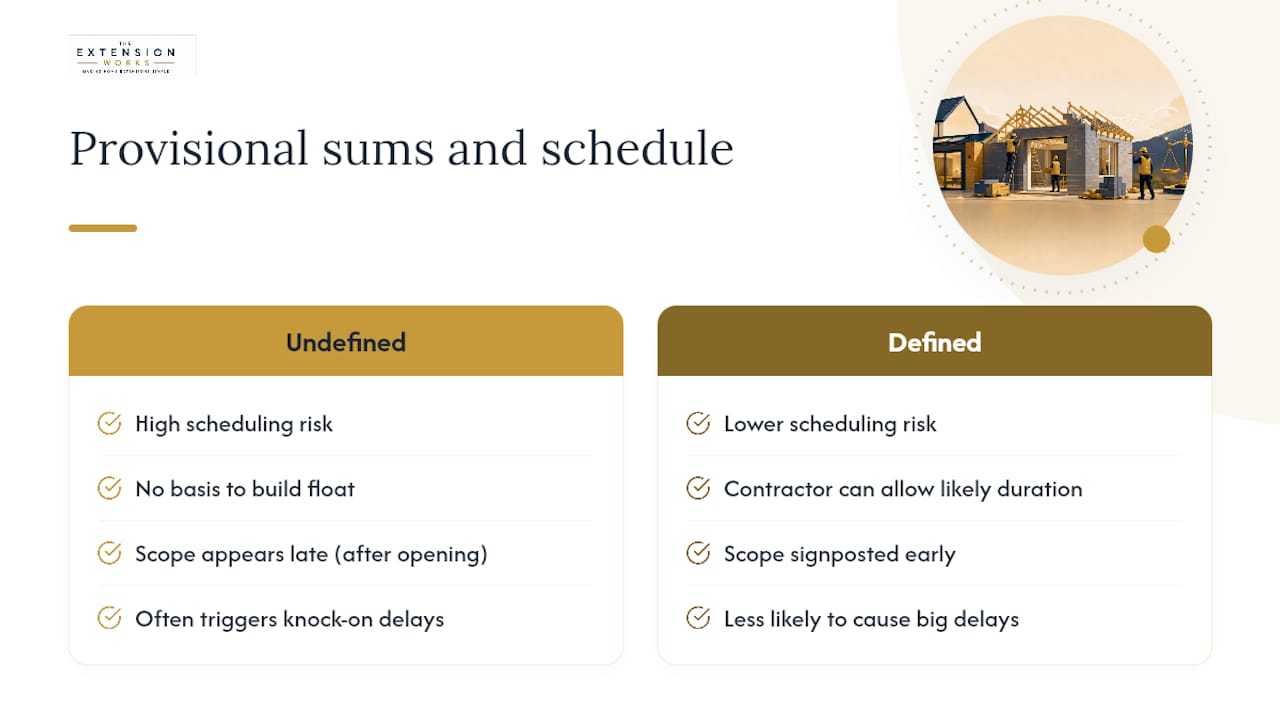
An undefined provisional sum is the bigger timeline risk of the two, because the contractor has no basis to build float into the programme for it. When the scope finally emerges, often after opening up foundations or existing walls, the resulting instruction can trigger a knock-on delay to every trade sequenced after it. A defined provisional sum, by contrast, at least gives the contractor a fighting chance to allow for likely duration in the original programme, even if the exact cost stays open.
The practical fix is sequencing: push as many provisional items as possible to be resolved before the trade that depends on them is due to start, not after. On a rear extension, that usually means committing to a foundation design the moment ground conditions are confirmed, rather than leaving it open while groundworkers stand idle. Projects that leave multiple undefined provisional sums unresolved simultaneously are the ones most likely to see their completion date slip by weeks rather than days.
Provisional sums under JCT and NEC contracts
The mechanics differ slightly depending on which standard form you’re using, though the underlying logic, allowance now, actual cost later, stays constant.
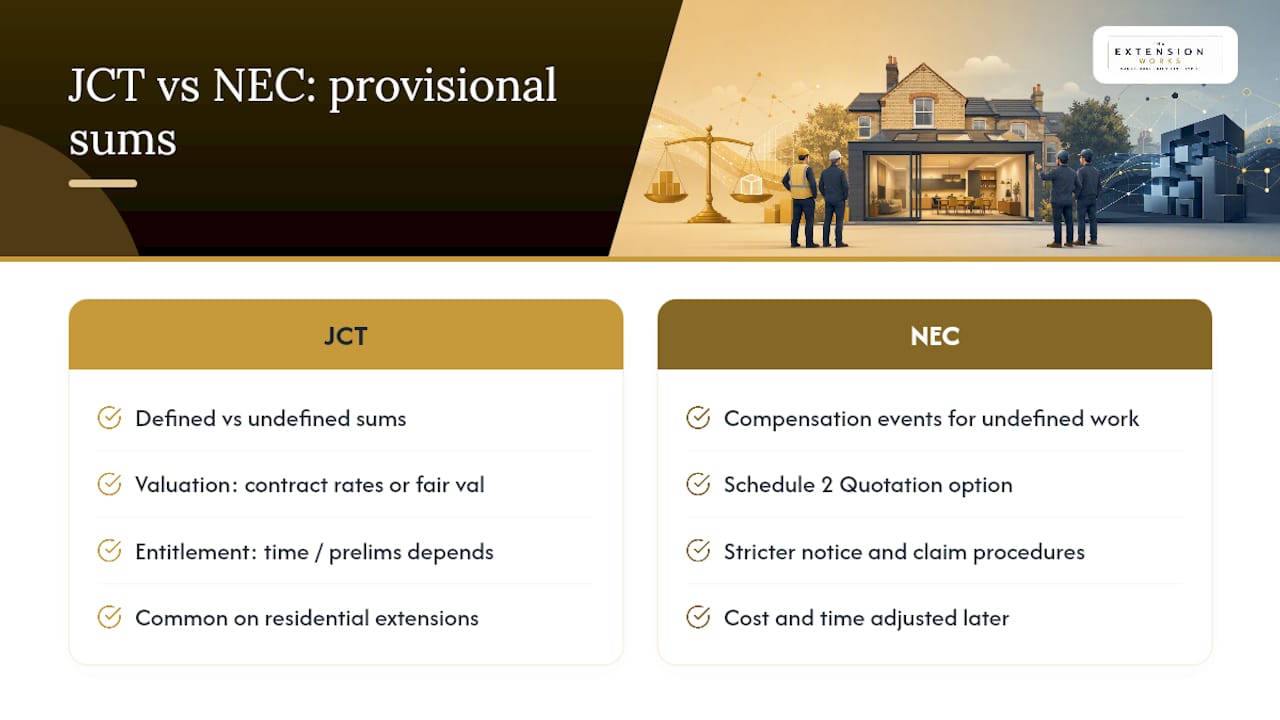
Under JCT contracts (the form most commonly used on residential extension work), provisional sums for defined work are priced using the contract’s valuation rules, generally by reference to rates already in the contract for similar work, or on a fair valuation basis where no comparable rate exists. JCT explicitly distinguishes defined from undefined sums in its guidance, and the contractor’s entitlement to extra time or preliminaries hinges on which category applies.
NEC contracts take a different structural approach. Rather than a bill of quantities style provisional sum, NEC projects typically deal with undefined scope through compensation events, or through mechanisms like a Schedule 2 Quotation for pricing changed or additional work. The effect is broadly similar, cost and time get adjusted once scope is known, but the paperwork and time limits for making a claim are stricter and more procedural under NEC than under most JCT forms.
For a homeowner signing a bespoke or JCT Minor Works contract for a rear extension, the practical takeaway is simpler than the underlying legal architecture: know which valuation rule your contract uses, and know the notice periods that apply before you need them.
Get a fixed-price rear extension quote
If you’d rather avoid provisional-sum guesswork altogether, The Extension Works’ instant quote tool gives you a fixed, VAT-inclusive price for a single-storey rear extension before you commit to anything, built around live 3D modelling so the design decisions that usually stay “provisional” elsewhere are settled up front.
The editorial take: why fewer provisional sums beats better management of them
Most guidance on this subject focuses on managing provisional sums well: fix the margins, keep the register, chase the paperwork. That advice is sound, but it treats the symptom. The real lesson buried in the Construction Leadership Council’s own recommendation, to advance design and shrink provisional sums before tender, is that the best dispute avoidance happens before the contract is signed, not during administration.
Homeowners are routinely told to “get everything in writing” once a provisional sum is instructed. Fair advice, but late. The higher-leverage moment is refusing to sign a contract where core items, ground conditions especially, remain undefined when they could reasonably have been investigated first. A single trial pit costs a fraction of the dispute it might prevent.
If there’s one priority worth taking from this: push your designer or contractor to resolve as much as possible before contract, and treat every remaining provisional sum as a known unknown with a named owner and a deadline, not an open-ended risk sitting quietly in the paperwork.
— Esskay
Sources
This explainer draws on the Designing Buildings Wiki for the core definition and defined/undefined split, LexisNexis for the contractual valuation mechanics, and the Court of Appeal’s ruling in Midland Expressway v Carillion for the binding legal interpretation. Practical drafting and dispute-avoidance advice comes from Consultancy.uk and the Construction Leadership Council. Always check your own contract’s specific clauses before relying on general guidance, since the wording you signed overrides any general industry convention.
- Provisional sum — Designing Buildings Wiki
- Provisional sum meaning in UK Law - LexisNexis
- Midland Expressway Limited v Carillion Construction Limited EWCA Civ. 936 — BAILII
- Consultancy
- Provisional sums guidance — Construction Leadership Council (ECA/CLC)