
Heat pump vs boiler: which is right for your extension?
Deciding between a heat pump vs boiler for your extension? Discover the benefits and which is the best long-term choice for your home.

Heat pump vs boiler: which is right for your extension?
If you are planning a single-storey rear extension and your boiler is on its last legs, the honest answer is: a heat pump is the better long-term choice if you are upgrading insulation and staying put for 10 or more years. If you need heat back on within 48 hours, replace like-for-like with a boiler and revisit the decision when the extension is designed.
The core technical difference shapes everything else. Gas boilers push water at 65–75°C, which means your existing radiators work fine. Heat pumps run at lower flow temperatures that deliver heat slowly and steadily. That gap matters enormously during an extension build: you may need larger radiators, underfloor heating in the new room, or both.
- Your extension is the ideal moment to make the switch, because walls are open, floors are being laid, and a heat-pump-friendly design can be built in from the start rather than retrofitted later.
- The Boiler Upgrade Scheme (BUS) currently offers up to £7,500 cashback on eligible air source heat pump installs in England and Wales, valid until at least March 2028.
- The Energy Saving Trust recommends pairing a heat pump with a heat-pump-friendly time-of-use tariff to maximize running-cost savings.
Pro Tip: Do not book a like-for-like boiler swap until you have spoken to your extension designer. A few weeks’ patience could save you the cost of a second system change.
Table of Contents
- How do heat pumps and boilers compare for an extension project?
- What should you check before choosing your heating system?
- What does fitting a heat pump or boiler mean for your extension build?
- What are the real costs and grants for heating during an extension?
- How do you fit heating works into your extension programme?
- How much maintenance do heat pumps and boilers need?
- How The Extension Works handles the heating decision in a real project
- Which heating system should you choose? Three scenarios
- Key takeaways
- Why heating decisions belong at the design stage, not the end
- Plan your extension with heating built in from the start
- Useful sources
How do heat pumps and boilers compare for an extension project?
A well-installed air source heat pump typically achieves a SCOP of 3.0–4.0, meaning 3–4 kWh of heat for every 1 kWh of electricity used. That efficiency advantage is real, but it depends heavily on insulation quality and radiator sizing.
Key figure: After the BUS grant, most air source heat pump installs are significantly more expensive than gas combi boilers.
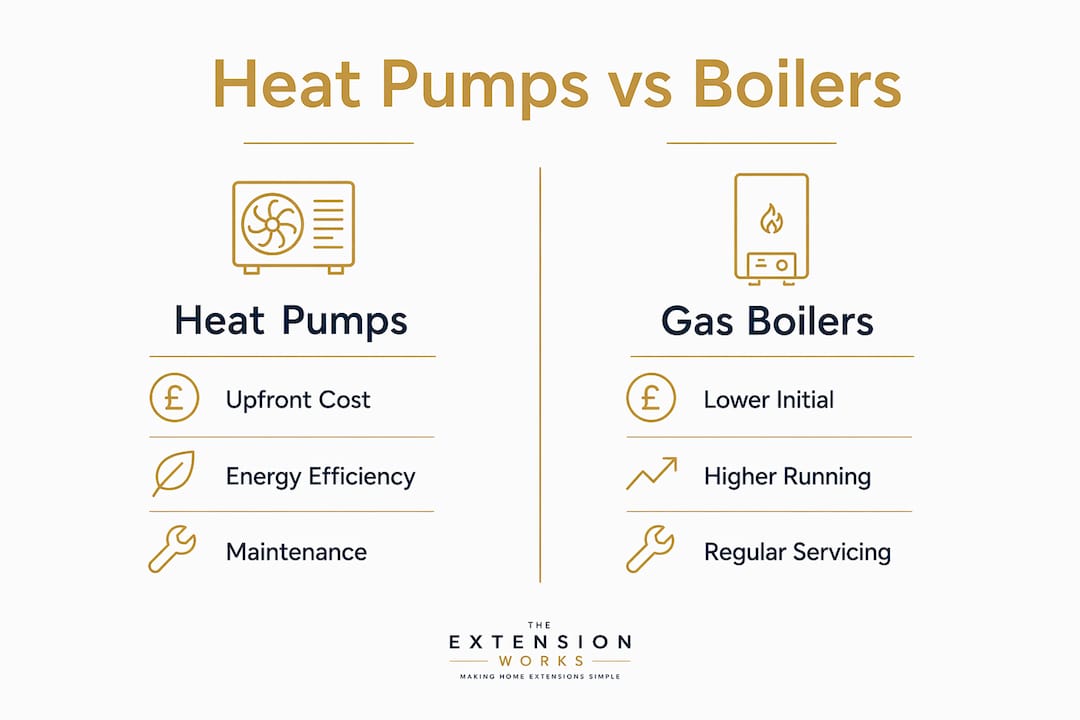
| Dimension | Air source heat pump | Gas boiler |
|---|---|---|
| Upfront cost (installed) | £8,000–£14,000 before grant; after BUS grant, most air source heat pump installs reduce to roughly £500–£8,500 depending on scope | £2,000–£4,500 |
| Running cost / efficiency | SCOP 3.0–4.0; cheaper on heat-pump tariff | Depends on tariff; gas boilers usually cheaper on standard tariffs, but heat pumps may be cheaper with heat-pump-specific tariffs |
| Carbon emissions | Lower under UK grid mix; improves as grid decarbonises | Higher; locked to gas |
| Installation time | 2–5 days plus radiator/UFH work | 1–2 days |
| Building fabric impact | Needs EPC C or better; radiator upsizing or UFH likely | Minimal; works with existing radiators |
| Space and siting | External unit needs clear airflow; cylinder cupboard required | Compact; no external unit |
| BUS grant eligibility | Yes, up to £7,500 (England and Wales) | No |
| Expected lifespan | 20–25 years | 10–15 years |
What should you check before choosing your heating system?
Start with your EPC band. Homes below EPC C risk poor heat-pump performance and higher running costs unless fabric upgrades are done first. Your extension is the natural point to address that.
Gather these before getting quotes:
- Your most recent EPC certificate and energy-use history (12 months of bills required for BUS).
- Current boiler age and condition.
- Existing pipework diameters (15mm or 22mm).
- Planned floor coverings in the extension (screed suits underfloor heating; timber joists suit radiators).
- Loft and wall insulation levels.
- Available garden or side-return space for an external unit, and proximity to neighbouring windows.
Ask every installer these questions during the extension tender:
- Can you provide a room-by-room heat-loss calculation and hydraulic design?
- Which radiators need upsizing, and what is the cost?
- What flow temperature will the system be designed for?
- Which heat-pump tariff do you recommend, and will you help me switch?
- Is the system MCS-accredited for BUS eligibility?
Pro Tip: A hybrid system, pairing a heat pump with a retained gas boiler as backup, suits period properties with high heat loss where a pump alone cannot keep up in cold snaps. Installed cost runs £12,000–£18,000 pre-BUS, so it is a transitional option rather than a permanent solution.

What does fitting a heat pump or boiler mean for your extension build?
A heat pump requires more coordinated design work than a boiler swap. That is not a reason to avoid it; it is a reason to plan it early.
- External unit location: needs clear airflow clearance, typically 300mm from walls, away from bedrooms and neighbour windows to manage noise.
- Condensate routing: must drain to a suitable point; plan this during groundworks.
- Hot-water cylinder: most heat pumps need a separate cylinder (180–250 litres), so a cupboard must be designed into the layout.
- Electrical supply: heat pumps typically need a dedicated 32–40A circuit; older consumer units may need upgrading.
- Radiator upsizing: a typical 3-bed semi needs 4–6 radiators replaced at roughly £120–£220 each fitted.
- Underfloor heating in the extension: the new room is the ideal candidate; screed floor and insulated slab are specified at foundation stage.
- MCS accreditation: your installer must hold MCS certification for Building Regulations compliance and BUS eligibility.
The Extension Works coordinates M&E (mechanical and electrical) trades alongside structural and architectural work, so heating plant locations appear on planning drawings from the outset rather than being squeezed in at the end.
Pro Tip: Schedule radiator upsizing and cylinder installation after first-fix plumbing but before floor finishes and decoration. Doing it in the wrong order means lifting new floors or repainting finished walls.
What are the real costs and grants for heating during an extension?
The BUS grant of up to £7,500 is applied directly by your MCS-accredited installer and deducted from the invoice. You do not claim it yourself. Eligibility requires an MCS-accredited installer, a valid EPC, and 12 months of fuel-use history. Scotland offers combined grant and loan support up to £15,000 via Home Energy Scotland.
Running-cost reality: On April 2026 Ofgem tariff rates (gas 6.04p/kWh, electricity 23.18p/kWh), a well-insulated 4-bed detached on a standard tariff saves roughly £110–£186 per year with a heat pump. On a heat-pump-specific tariff such as Octopus Cosy or OVO Heat Pump Plus, where off-peak electricity costs 12–18p/kWh, that saving grows considerably.
| Cost item | Heat pump (after BUS) | Gas boiler |
|---|---|---|
| Installed cost | £500–£8,500 (after BUS grant, depending on scope) | £2,000–£4,500 |
| Radiator upsizing (if needed) | £120–£220 (4–6 rads) | Nil |
| Cylinder cupboard build | — | Nil |
| Expected replacement | After 20–25 years | After 10–15 years |
Lifetime economics to weigh up:
- A SCOP below 3.0 makes a heat pump more expensive to run than gas at current tariffs; insulation quality is the single biggest determinant.
- If you move within 8 years, you are unlikely to recover the install premium on running costs alone.
- If gas prices rise and the electricity grid continues to decarbonise, the economics shift in the heat pump’s favour over a 10–15-year horizon.
- VAT on heat pump installations is currently 0% for qualifying residential installs; confirm with your installer.
Factoring heating upgrades into your total rear extension budget from the start avoids the common mistake of treating them as an afterthought.
How do you fit heating works into your extension programme?
A boiler swap takes 1–2 days; a heat pump installation typically takes 2–5 days, with additional days for radiator and cylinder work. In a 12–16 week single-storey extension build, heating works slot in during weeks 8–12, after first-fix plumbing and electrical rough-in but before plastering and floor finishes.
Scheduling steps:
- Commission a heat-pump survey during the design stage, not after planning approval.
- Book the electrical upgrade (if needed) to align with first-fix electrical works.
- Allow a supply lead time of 2–4 weeks for the outdoor unit and cylinder.
- Schedule radiator replacements after first-fix plumbing, before plastering.
- Allow 1–2 days for commissioning, testing, and MCS certification sign-off.
If the existing heating system must be decommissioned mid-build, arrange temporary electric panel heaters or a hired boiler unit. Check your home insurance policy before works begin, as some policies require notification when the main heating system is out of service.
How much maintenance do heat pumps and boilers need?
Heat pumps generally last longer and have higher annual servicing costs than gas boilers, which usually require replacement at least once over a typical 20-year ownership period.
- Heat pump performance varies with outdoor temperature; a well-insulated extension buffers this, keeping SCOP closer to the design figure even in cold snaps.
- Boilers require annual Gas Safe checks; skipping them can void manufacturer warranties and affect home insurance.
- Check that your appliance warranty and The Extension Works’ 12-month workmanship warranty are complementary, not overlapping, so you know which covers what if a fault appears in year one.
How The Extension Works handles the heating decision in a real project
Consider a semi-detached 3-bed in South London, owners planning to stay for 12 years, extending to the rear with a new kitchen-diner. EPC band D on arrival. The decision: heat pump, once insulation upgrades are built into the extension specification.
How the project unfolds with The Extension Works:
- Live 3D modelling shows the external unit position, cylinder cupboard, and underfloor heating zone in the new room before a brick is laid.
- EPC review flags the insulation shortfall; loft top-up and cavity wall fill are added to the specification.
- An MCS-accredited installer surveys during the design stage and sizes the system against the post-extension heat loss.
- Radiator upsizing schedule is agreed before tender, so costs are fixed rather than discovered on site.
- BUS application is coordinated alongside the build programme.
- The project completes under a fixed VAT-inclusive price with a 12-month workmanship warranty covering all trades.
Which heating system should you choose? Three scenarios
- Short stay or urgent replacement (under 8 years, boiler failed): Replace with a gas boiler. The BUS economics do not stack up if you will not be there to benefit from lower running costs, and a boiler is back on in a day.
- Long-term owner with planned extension and insulation upgrades (10+ years): Choose a heat pump. The BUS grant, lower replacement frequency, and insulation-driven SCOP gains make the lifetime case. Design the extension around it from the start.
- Period property with high heat loss (EPC E or below, solid walls): Consider a hybrid. A heat pump handles the bulk of the year; the retained boiler covers the coldest spells. Prioritise fabric upgrades in the extension specification to improve the heat pump’s share over time.
A hybrid also makes sense when a gas boiler has several years of life left and a full heat-pump transition feels premature. Retaining it as backup costs more upfront but reduces risk during the transition.
Key takeaways
For most homeowners planning a single-storey rear extension, a heat pump is the right long-term choice when insulation upgrades are included and the BUS grant is claimed before March 2028.
| Point | Details |
|---|---|
| Heat pump flow temperature | Heat pumps run at 45–55°C, so radiator upsizing or underfloor heating is usually needed. |
| BUS grant reality | The BUS grant can reduce the installed cost of an air source heat pump by up to £7,500 in England and Wales, bringing most installs to roughly £500–£8,500 depending on scope. Requires MCS installer and valid EPC. |
| Insulation first | Homes below EPC C risk poor SCOP and higher running costs; address fabric in the extension spec. |
| Installation timeline | Heat pump installs take 2–5 days plus radiator work; plan this into weeks 8–12 of your build programme. |
| The Extension Works | Coordinates heating decisions, BUS paperwork, and 3D visualisation within a fixed-price, warranted build. |
Why heating decisions belong at the design stage, not the end
The conventional wisdom is to sort the structure first and worry about heating later. That is the wrong order, and it costs money. By the time a builder is on site, the floor screed is poured, the cylinder cupboard is not in the drawings, and the electrical panel has not been upgraded. Every one of those omissions becomes a variation order.
The heat pump vs boiler decision is not really a heating question. It is a design question. The flow temperature you choose determines radiator sizes, floor construction, electrical load, and where the outdoor unit sits relative to your neighbours. Get that wrong in the drawings and you pay to fix it on site.
There is also a timing argument that most guides miss. The BUS grant requires an MCS-accredited installer, a valid EPC, and 12 months of fuel-use history. If your extension improves your EPC band, the new certificate may actually help your eligibility rather than hinder it. But only if the application is timed correctly. That is the kind of detail that falls through the cracks when heating is treated as a separate trade rather than part of the design.
Plan your extension with heating built in from the start
The Extension Works gives you a fixed VAT-inclusive price for your single-storey rear extension, with live 3D modelling so you can see exactly where the external unit sits, how the cylinder cupboard fits into the layout, and which rooms get underfloor heating before any work begins.

What is included for heating coordination:
- EPC review and fabric upgrade recommendations built into the specification.
- M&E coordination with MCS-accredited heat pump installers.
- BUS application assistance timed to your build programme.
- Radiator upsizing scheduled and priced before tender, not discovered on site.
- Fixed pricing and a 12-month workmanship warranty covering all trades.
Ready to see what your extension costs with heating factored in? Get an instant quote or visit The Extension Works to learn how the end-to-end service works.
Useful sources
- Boiler Upgrade Scheme guidance — grant amounts, eligibility conditions, and application process for England and Wales.
- Energy Saving Trust — independent guidance on heat pump performance, tariffs, and insulation priorities for UK homeowners.
- MCS installer standards — explains MCS accreditation requirements for BUS eligibility and Building Regulations compliance.
- Running-cost comparison with Ofgem tariff data — detailed cost modelling by home type using April 2026 Ofgem cap rates.
- Heat-pump tariff guidance — practical advice on time-of-use tariffs and how they affect running-cost outcomes.
Recommended
- Flat roof vs pitched: which is right for your extension? — The Extension Works
- Extension planning drawings: a homeowner’s guide — The Extension Works
- Building work hours: a homeowner’s guide to faster extensions — The Extension Works
- Rear extension cost in 2026: a UK homeowner’s guide — The Extension Works