
Lawful development certificate for extensions: your guide
Discover how a lawful development certificate for extensions can protect your project and help ensure compliance with planning regulations.
Lawful development certificate for extensions: your guide
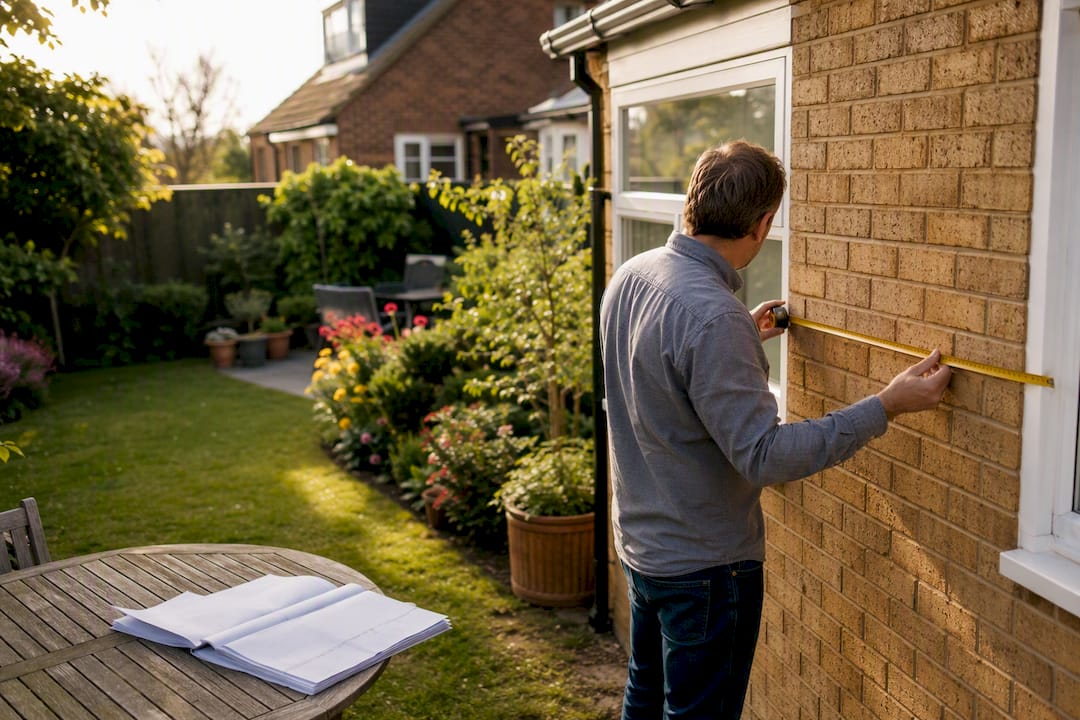
A lawful development certificate (LDC) is your council’s legal confirmation that an existing or proposed extension is lawful for planning purposes. It is not planning permission, and it doesn’t replace a single other consent you might need. If you’re unsure whether your extension needs one, here’s what to do right now:
- Uncertain about permitted development limits? Apply for a certificate before you build.
- Already built without permission? Start gathering dated evidence immediately.
- Relying on permitted development rights? Get a Certificate of Lawfulness of Proposed Use or Development (CLOPUD) before the diggers arrive.
Three organisations matter here: GOV.UK sets the legal framework, the Planning Portal handles the application process, and your local planning authority makes the actual decision.
Key Takeaways
A lawful development certificate confirms an extension is legally lawful but never substitutes for planning permission, Building Regulations approval, or other statutory consents.
| Point | Details |
|---|---|
| Two application types exist | CLOPUD (section 192) covers proposed works; CLEUD (section 191) covers existing, already-built extensions. |
| Fees differ by type | Proposed-development fees run roughly half a full planning fee; existing-development fees match the full fee. |
| Decisions take up to eight weeks | Councils aim to decide validated applications within eight weeks, so submit evidence in full upfront. |
| Refusals can be appealed | Unsuccessful applications go to the Planning Inspectorate, which retests the same lawfulness question. |
| The Extension Works reduces refusal risk | Its in-house team prepares precise drawings and evidence bundles before submitting LDC applications for your extension. |
Table of Contents
- What is a lawful development certificate extension approval?
- Do you need a certificate of lawfulness for your extension?
- Proposed development or existing use: which application do you need?
- What evidence does an LDC application need?
- How do you apply for a certificate of lawfulness?
- What if your application is refused?
- Why proactive applications beat reactive ones
- Get your extension application right the first time
- Frequently asked questions
- Sources
What is a lawful development certificate extension approval?
A lawful development certificate is a legal document from your council confirming that building work is lawful, or that proposed work won’t need planning permission. It’s decided purely on facts and law, not on whether the planning officer likes your design.
Here’s what an LDC actually does:
- Confirms lawfulness of the specific matter described in the application.
- Gives immunity from enforcement action on that matter.
- Records the legal position as of the application date.
Here’s what it doesn’t do:
- It is not planning permission and carries no design approval.
- It doesn’t replace Building Regulations sign off, party wall agreements, or restrictive covenant checks.
- It stops protecting you the moment something material changes after the certificate date.
Think of it as a snapshot, not a warranty. Change the extension later, and you’re outside the picture it captured.
Do you need a certificate of lawfulness for your extension?
Run through this checklist before deciding:
- Selling or remortgaging? Apply now. Buyers’ solicitors and lenders routinely ask for proof that extensions are lawful, and without it you risk delays or indemnity insurance demands during conveyancing.
- Building close to permitted development limits? Get a CLOPUD before starting. Marginal cases are exactly where disputes happen later.
- Extension built without permission years ago? Apply for retrospective confirmation, especially if enforcement risk exists.
- Comfortably within permitted development, no plans to sell soon? An LDC is optional here, though many owners still get one for peace of mind.
Solicitors and mortgage lenders don’t take your word for it. Paperwork settles the question fast.
Proposed development or existing use: which application do you need?
There are two distinct routes, and mixing them up wastes time and money.
A section 192 certificate (CLOPUD) covers proposed development. You apply before building, submitting drawings that demonstrate your plans comply with permitted development limits. Picture a homeowner planning a 2026 single-storey rear extension who wants written confirmation it falls under permitted development before signing a builder’s contract.
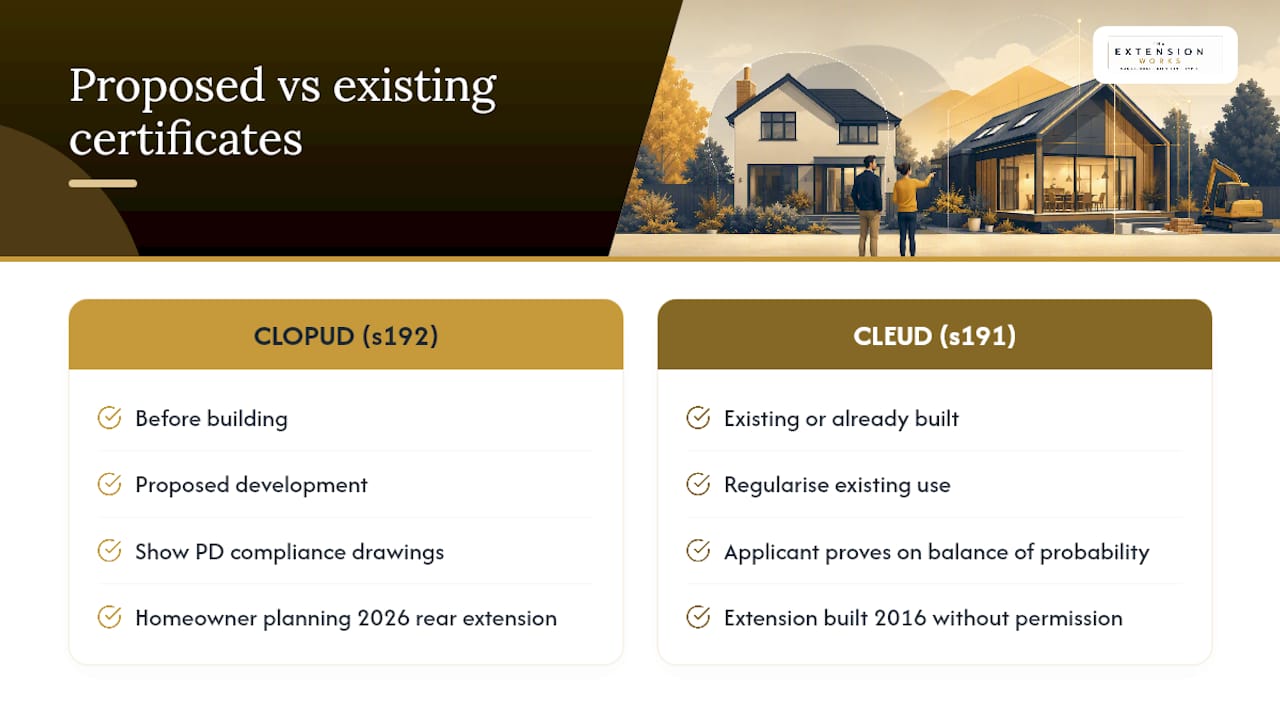
A section 191 certificate (CLEUD) covers existing use or development. You apply to regularise something already built or already happening. The burden of proof sits entirely with you, and the council decides on the balance of probabilities. Imagine an extension built in 2016 without permission, where the current owner now needs formal confirmation before selling.
Get the wrong form, and validation stalls before assessment even starts.
What evidence does an LDC application need?
Councils reject vague applications. A proposed-development case needs precise drawings and a demonstration of compliance with permitted development rules; an existing-use case needs proof that stands up to scrutiny.
For a CLEUD, gather:
- An accurate, scaled location plan and site plan.
- Elevation and section drawings showing what was actually built.
- Dated photographs covering construction stages, not just the finished result.
- Invoices and receipts from builders or suppliers, ideally date-stamped.
- Utility bills and council tax records that anchor a timeline.
- Tenancy agreements, if occupation history supports your case.
- Statutory declarations or witness statements from tradespeople or neighbours where documentary evidence is thin.
Label every drawing with a date and reference the specific permitted development paragraph you’re relying on. Describe the development precisely on the application form. “Single-storey rear extension, 4.2 metres depth, completed March 2016” beats “rear extension” every time.
The most common pitfalls are inconsistent dates across documents, unsigned statutory declarations, and applicants submitting half the evidence they actually have because they assume the council will “just check.” Councils won’t chase evidence for you. Precise, consistent, uncontradicted bundles win CLEUD applications; vague or partially dated ones tend to get refused.
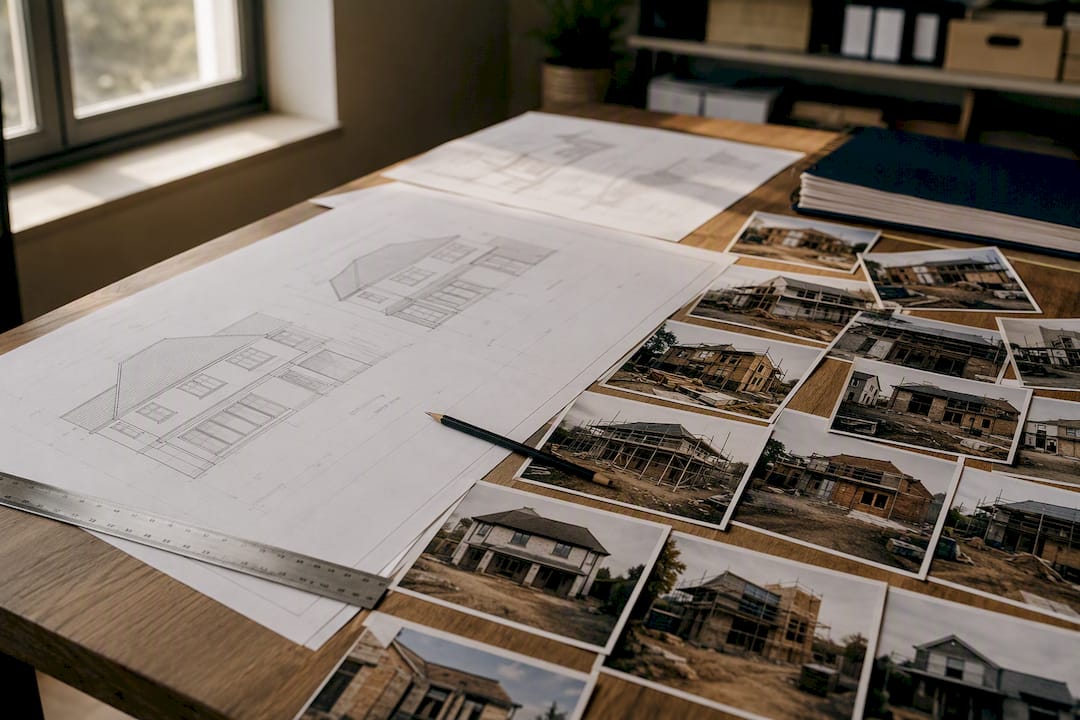
For a small rear extension, the minimum a council will realistically expect is a location plan, elevation drawings, at least two dated photographs from different construction stages, and one piece of independent documentary evidence such as a council tax record or invoice.
Pro Tip: A statutory declaration from the builder who did the work, combined with date-stamped photos taken during construction rather than after completion, carries far more weight than photos alone. Councils know finished-extension photos prove nothing about when the work happened.
How do you apply for a certificate of lawfulness?
Once your evidence is ready, the process runs in a fairly predictable order:
- Prepare your drawings and evidence bundle.
- Complete the correct form, either the section 191 or section 192 version.
- Submit through the Planning Portal or directly to your local planning authority.
- Wait through the validation period, when the council checks your submission is complete.
- Receive a decision, usually within eight weeks of validation.
On fees: proposed-development applications generally cost about half the equivalent full planning application fee, while existing-development certificates usually attract the full fee. Figures are re-indexed each April, so check the Planning Portal fee calculator before you submit rather than relying on last year’s number.
If the council requests further information rather than refusing outright, respond quickly. Common requests include clearer photographs, an additional statutory declaration, or a corrected description of the development. Slow replies push your decision date back, since the clock effectively pauses while the council waits on you.
Pre-application advice from your local planning authority is worth considering for genuinely borderline cases, though it isn’t compulsory and adds its own fee and waiting time.
What if your application is refused?
If your council refuses, or fails to decide within the prescribed period, you can appeal to the Secretary of State via the Planning Inspectorate. The appeal tests the same narrow legal question the original application faced: does the evidence and law support lawfulness, regardless of what the council thinks of the design.
An LDC, even when granted, will not protect you against:
- Building Regulations non-compliance.
- Party wall disputes with neighbours.
- Restrictive covenants attached to the property.
- Anything that changes materially after the certificate date.
Common refusal reasons for extension applications include insufficient evidence for a CLEUD, measurements that exceed permitted development limits for a CLOPUD, and constraints like Article 4 directions or conservation area status that remove permitted development rights entirely. If you’re refused because your project plainly breaches the limits, applying again with the same evidence won’t help. You need either amended plans or full planning permission instead.
Why proactive applications beat reactive ones
Get a CLOPUD before you build whenever you’re relying on permitted development rights, particularly near the size limits. It costs less than a refused planning application and creates a paper trail no future buyer’s solicitor can question.

If you’re buying or selling a property with an extension lacking documentation, push for a CLEUD before completion. It’s cheaper than indemnity insurance and removes genuine uncertainty rather than just insuring against it.
Get your extension application right the first time
Most LDC refusals come down to weak drawings or thin evidence bundles, not bad luck. The Extension Works handles permitted development checks, planning drawings, and evidence-bundle preparation as part of its design-to-build service, so the application that lands on your council’s desk is precise from the start.
Every project gets accurate, dated drawings and direct handling of any follow-up queries from the local planning authority, which is usually where applications stall, supported by expert building services for residential developments to ensure compliance and smooth progress. You’ll see your extension modelled with live 3D visualisation before committing to anything, backed by a fixed VAT-inclusive price and a 12-month workmanship warranty. If you’re weighing up a rear extension in Sutton or Morden and want to know where you stand on permitted development, get an instant quote and find out before you spend a penny on plans.
Frequently asked questions
Do I need a lawful development certificate for a small rear extension? Not always. If your extension clearly falls within permitted development limits and you don’t plan to sell soon, an LDC is optional. It becomes strongly advisable once you’re near size limits or planning a sale.
What’s the difference between a lawful certificate and planning permission? Planning permission grants approval to build something new. An LDC simply confirms that work already complies with the law, whether built or proposed, and carries no design judgment.
How long does a certificate of lawful use application take? Councils typically decide within eight weeks of validation, though incomplete evidence bundles or requests for further information can extend this.
Can I apply for an LDC after building without permission? Yes, through a section 191 existing-use certificate. You’ll need to prove the work has stood, in most residential cases, for a continuous period without enforcement action, backed by dated evidence.
What happens if my LDC application gets refused? You can appeal to the Planning Inspectorate. Refusal usually means your evidence was insufficient or your measurements exceeded permitted development limits, so review both before reapplying.
This article is general information, not a substitute for advice from a qualified lawyer. Consult a qualified legal professional about your own circumstances before acting on anything here.
Sources
- Gov
- Lawful Development Certificate - Consent types - Planning Portal
- Certificates of lawfulness (development certificates) — statutory guidance (PDF)
- A guide to Lawful Development Certificates - Planning to Build
- Lawful Development Certificate (LDC) — Planning Permission Checker