
What are typical structural engineer fees for an extension?
Discover typical structural engineer fees for home extensions in England. Get fixed rates that simplify budgeting for your project.
What are typical structural engineer fees for an extension?
For a single-storey rear extension in England, structural engineering work typically costs a fixed fee within a moderate range. That covers the design, calculations, and a signed pack ready for Building Control. Domestic jobs are almost always quoted as a fixed fee rather than an hourly rate, which makes budgeting far easier than with open-ended professional services.
Headline ranges to work from:
- Single beam or RSJ calculation: £300–£600
- Full single-storey extension structural design: £500–£1,500
- Full structural survey: £400–£900
Fee snapshot: London and the South East typically add a 15–25% premium on top of these figures, so a £1,200 design fee elsewhere in England can easily reach £1,400–£1,500 in the capital.
Before accepting any quote, check two things: that the paperwork will be Building Control-ready, and that the engineer is chartered. Skip either and you risk delays or a rejected completion certificate later.
Key Takeaways
Structural engineer fees for a typical rear extension in England range from £300 for a single beam calculation to £1,500 for a full design package, and fixed pricing is standard for defined domestic scopes.
| Point | Details |
|---|---|
| Fee ranges by deliverable | Beam calcs cost £300–£600, full extension design £500–£1,500, surveys £400–£900. |
| Fixed fee is standard | Domestic jobs are usually quoted as a fixed fee; hourly rates apply mainly to investigative or open-ended work. |
| London premium applies | Expect a 15–25% uplift on these ranges across London and the South East. |
| Scope for chartered status | Only CEng-qualified engineers with IStructE or ICE membership produce calculations Building Control will accept. |
| Coordination reduces risk | The Extension Works combines structural, design, and planning work in-house with fixed pricing to avoid mismatched paperwork. |
Table of Contents
- Fee breakdown: typical costs by deliverable and scope
- What drives the price on your quote?
- How engineers typically charge, and what to insist on
- How to avoid hidden costs and speed up sign-off
- Why chartered status and a fixed-price approach matter
- What the numbers actually tell you
- Getting a fixed-price structural quote without the coordination headache
- Sources
Fee breakdown: typical costs by deliverable and scope
The number on your quote depends entirely on what you’re asking the engineer to produce. A single steel beam over a doorway is a different job from redesigning the load path for a full rear extension, and the price reflects that gap.
A single beam or RSJ calculation typically runs £300–£600, though some online calculators advertise entry prices as low as £60. That headline figure often excludes a site visit or a full signed calc pack, so check what’s actually included before assuming it covers Building Control. The proper deliverable includes a site measurement, sizing calculations, a written specification, and a signed calc pack your builder and Building Control can both rely on.
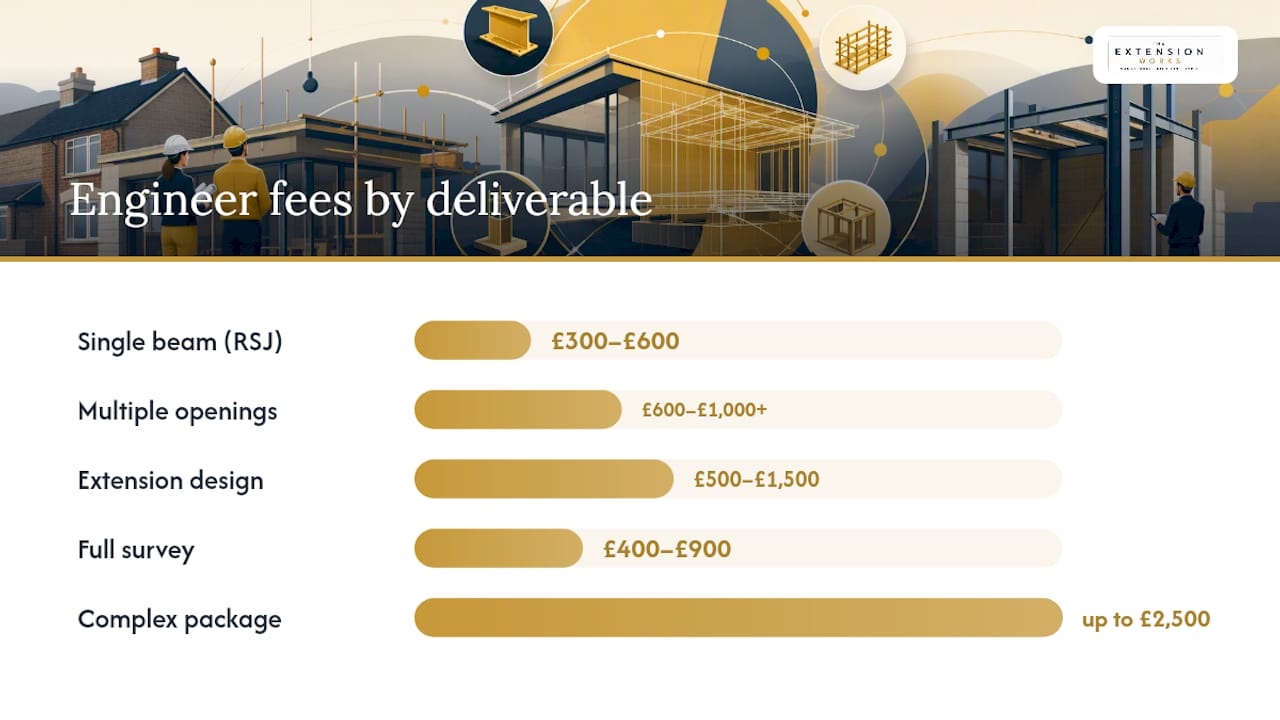
Knock through two or three walls instead of one, and fees climb because each opening interacts with the others structurally. Expect a higher band, often £600–£1,000+, since the engineer has to model how loads redistribute across the whole rear wall rather than a single point.
Full extension structural design for a typical single-storey rear addition sits at £500–£1,500, covering foundation design, beam sizing, and connection details, everything a contractor needs to build from.
| Deliverable | Typical fee range |
|---|---|
| Single beam/RSJ calculation | £300–£600 |
| Multiple beams / knock-through | £600–£1,000+ |
| Single-storey extension design | £500–£1,500 |
| Full structural survey | £400–£900 |
A full structural survey costs £400–£900 and covers an assessment of existing walls, floors, and foundations, useful if you’re extending onto an older property or one with visible cracking. Complex packages from any provider can run up to £2,500 where the scope is large or unusual.
What drives the price on your quote?
Quotes for what looks like the same job can vary by hundreds of pounds. Six factors explain most of that gap.
- Scope and complexity matter more than anything else. A steel beam spanning 3 metres is simpler to calculate than one spanning 6 metres with a point load from above.
- Site conditions push costs up. Sloping gardens, made-up ground, or evidence of past subsidence often mean extra investigation before any calculation can start.
- Deliverable format changes the price. A signed calc pack costs less than full construction drawings, and both cost less than ongoing construction-phase support.
- Liability exposure raises fees for specialist work. An engineer taking on subsidence remediation carries more professional risk than one sizing a standard beam, and the fee reflects that.
- Site visits and revisions add up. Each additional visit or redesign after architect drawings change usually costs extra unless it’s agreed upfront.
- Location shifts the baseline. London and the South East carry a 15–25% premium over the rest of England.
Pro Tip: Ask your engineer to confirm in writing how many site visits and revisions are included in the fixed fee. That single question prevents most of the “surprise” invoices homeowners complain about.
How engineers typically charge, and what to insist on
Most engineers price domestic extension work as a fixed fee for a defined scope, and that’s deliberate: both parties know the number upfront, and it protects you from open-ended billing on a job with clear boundaries.
Hourly rates appear when the work is genuinely unpredictable, investigating an unexplained crack, assessing subsidence, or supporting a contractor through an unusually complicated build. Rates commonly sit around £80–£150 per hour. If you’re quoted hourly, ask for a “not to exceed” cap so the job can’t run away from the original estimate. Percentage-of-build-cost fees turn up mainly on large or commercial-scale projects, rarely on a standard rear extension.
Whatever the structure, get these in writing before you commit:
- Exact deliverables (calc pack, drawings, or both)
- What’s explicitly excluded from the fee
- Number of included site visits
- How revisions are priced
- Professional indemnity insurance limits
- Chartered status (CEng, IStructE, or ICE)
- Expected turnaround time
On turnaround: beam calculations typically take 3–7 working days, a full survey 1–2 weeks, and a complete extension design package 2–4 weeks depending on how many rounds of revisions the architect’s drawings go through.
How to avoid hidden costs and speed up sign-off
The biggest cause of extra fees isn’t a badly written quote, it’s a badly scoped one. Follow this checklist before you sign anything.
- Demand Building Control-ready documentation in the fee itself, not as a separate add-on once the calcs are done.
- Fix the number of site visits in writing, and ask what extra visits cost if the job runs on.
- Agree revision terms upfront, particularly how changes to the architect’s drawings after calculations are finished will be priced.
- Confirm Chartered status and PI insurance limits directly. Chartered engineers hold IStructE or ICE membership, and their signed calculations are what Building Control needs to issue a completion certificate.
- Get your architect, contractor, and engineer talking early. Most costly rework happens when one professional’s drawings don’t match another’s assumptions.
Pro Tip: If your budget is tight, ground conditions and existing structural defects are the two things most likely to blow past a fixed fee. Ask specifically about both before you sign.
Why chartered status and a fixed-price approach matter
An engineer’s signature only carries weight with Building Control if they’re actually chartered. CEng status through IStructE or ICE isn’t a nice-sounding credential, it’s what stands between your extension and a completion certificate that gets refused.
That regulatory reality is exactly why coordination matters as much as the calculation itself. A signed calc pack that doesn’t match your architect’s drawings, or that Building Control rejects on a technicality, costs far more in delay than any fee saved upfront.
The Extension Works structures its fixed, VAT-inclusive pricing so structural work, architectural plans, and planning documentation are produced by one in-house team rather than three separate parties working from different assumptions.
Its instant quote tool and live 3D modelling let homeowners see a design and its likely cost before a single site visit is booked, closing the gap between what’s quoted and what’s delivered.
What the numbers actually tell you
The fee ranges in this article aren’t controversial, most UK guides land in similar territory. What’s underrated is how much the structure of a quote matters more than the headline number. A £400 fixed fee with clear exclusions beats a £600 quote where “site visits” and “revisions” are vague enough to mean anything.
Conventional advice tells homeowners to “get three quotes and compare the price.” That’s incomplete. Compare the scope first. A cheaper quote that excludes a signed calc pack for Building Control isn’t cheaper, it’s unfinished, and you’ll pay again later to complete it properly.
If there’s one thing to prioritise, it’s this: ask every engineer the same specific questions about deliverables, visits, and Chartered status before comparing a single number. The homeowners who avoid nasty surprises aren’t the ones who negotiated hardest on price. They’re the ones who scoped the job properly from the start.
— Esskay
Getting a fixed-price structural quote without the coordination headache
Most of the frustration homeowners describe isn’t really about the fee itself, it’s about the disconnect between engineer, architect, and builder, and who’s responsible when the paperwork doesn’t line up. The Extension Works was built to close that gap for single-storey rear extensions across Sutton and Morden.

Structural calculations, architectural plans, and planning permission handling all come from one in-house team, working from the same drawings from day one, rather than three separate quotes you have to reconcile yourself. Every price is fixed and VAT-inclusive, so the number you’re quoted for structural and design work is the number you pay, with no hourly surprises if ground conditions turn out to be tricky. You also get a dedicated project team and a 12-month workmanship warranty once the build is complete.
If you want to see what your own extension would cost with everything, structural work included, in one fixed figure, try the Instant Extension Quote Tool and get a live 3D model of your project in minutes.
Sources
- Regulated professions: chartered structural engineer
- Structural engineer cost UK 2026 | Fees by job
- Structural engineer costs and when you need one | ResiQuote
- Structural engineer cost 2026 | Fixed fees from £245
Recommended
- Planning fees for an extension: what England homeowners need to know — The Extension Works
- Structural calculations for extensions: the UK homeowner’s guide — The Extension Works
- Rear extension cost London: 2026 guide for homeowners — The Extension Works
- Rear extension cost in 2026: a UK homeowner’s guide — The Extension Works