
What skip size for extension work do you actually need?
Choosing the right skip size for your extension work is crucial. Learn which skip suits your waste type and avoid costly mistakes.
What skip size for extension work do you actually need?
For most single-storey extensions, choose a 6-yard skip if you’re clearing heavy, dense waste like soil, brick and rubble. Go for an 8-yard skip when your waste is mixed or lighter, such as timber, packaging and general construction offcuts. That’s the quick-answer recommendation most UK skip hire firms give, and it holds up well against real project experience.
Bigger extensions, especially those with substantial groundworks or a full loft conversion running alongside, often need more than one skip, or a grab lorry for the spoil. Before you book anything, though, three things can trip you up:
- Weight limits matter more than skip size once you’re dealing with soil or hardcore
- Highway permits are needed if the skip sits on a public road, not your driveway
- Hazardous waste like asbestos can never go in a standard mixed skip, whatever size you choose
Get those three right first, and picking between a 6-yard and an 8-yard becomes a much simpler decision.
Key Takeaways
Choosing the right skip size for an extension comes down to identifying your dominant waste type first, then checking weight limits and permit rules before booking.
| Point | Details |
|---|---|
| Match size to waste type | Use a 6-yard skip for heavy spoil and an 8-yard for mixed or light construction waste. |
| Weight limits bite early | Dense material like soil can hit weight caps at roughly a third to half full. |
| Permits depend on placement | Skips on the public highway need a council licence; those fully on private land usually don’t. |
| Hazardous waste needs specialists | Asbestos and certain chemicals require licensed removal, never a standard skip. |
| Stage hires by build phase | Booking skips to match demolition, groundworks and finishing stages avoids paying for unused capacity. |
Table of Contents
- Which waste types come from an extension, and why it changes your skip choice
- Skip sizes explained: from 4-yard to 16-yard
- Why weight limits matter more than skip size for heavy waste
- Do you need a permit for your skip?
- How many skips will your extension actually need, and what will it cost?
- What can’t go in your skip: asbestos, plasterboard and hazardous items
- Grab lorries and skip bags: when a skip isn’t the right tool
- Practical loading tips that cut skip hire costs
- Quick checklist: choosing your skip in five minutes
- Ready to skip the skip headache entirely?
- Where the standard advice on skip sizing falls short
- Sources
Which waste types come from an extension, and why it changes your skip choice
Extensions produce two very different waste streams, and confusing them is the single biggest reason people end up with the wrong skip. Heavy or dense waste includes soil, hardcore, bricks and concrete. It’s compact, weighs a lot per cubic yard, and hits weight limits fast even in a small skip. Light or bulky waste covers timber, packaging, old fittings, furniture and general site rubbish. It takes up volume without weighing much.
Plasterboard sits in its own category. Many councils and haulage firms won’t let you mix it with general waste because it releases hydrogen sulphide gas when it breaks down in landfill alongside other rubbish, so it often needs a separate skip or a dedicated bag.
Mapping waste to build phase helps you plan skip hire properly:
- Demolition and strip-out: bricks, old plaster, timber studwork, roofing material
- Foundations and groundworks: soil, subsoil, hardcore, concrete offcuts
- First fix and structure: timber, insulation packaging, plasterboard offcuts
- Finishing stage: packaging, tile cuttings, general site rubbish, old fixtures
Each phase tends to favour a different waste type, which is exactly why staging your skip hire around the build programme, rather than booking one skip for the entire project, usually works out cheaper and less stressful.
Skip sizes explained: from 4-yard to 16-yard
Once you know your dominant waste type, matching it to a size is straightforward. Here’s how the common options break down for domestic work, based on measured comparisons across the full skip range:
- 4-yard skip: small garden clearances, single-room strip-outs, roughly 30-40 bin bags
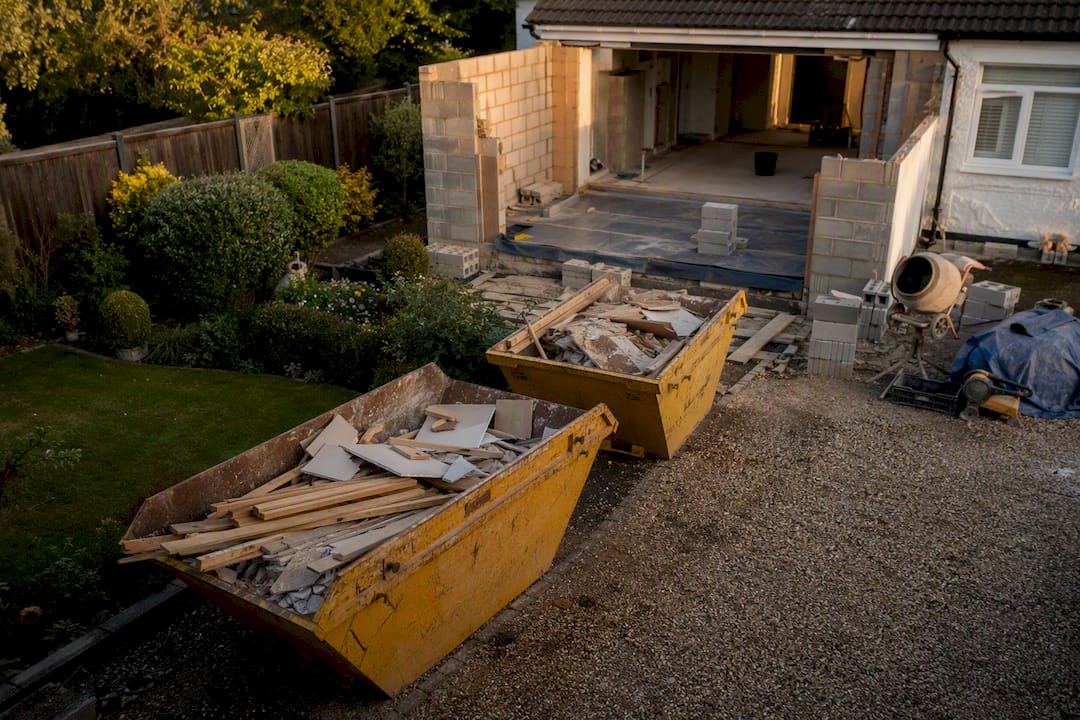
- 6-yard skip: holds around 50-60 bin bags, the standard choice for heavy waste on a single-storey extension, footprint roughly 1.8m by 3.6m
- 8-yard skip: around 60-80 bin bags, suited to mixed or lighter waste on larger single-storey jobs, similar footprint but taller sides
- 12 to 16-yard skips: used for larger extensions, loft conversions combined with ground-floor work, or trade sites clearing several rooms at once
A 6-yard skip typically holds 50 to 60 standard bin bags’ worth of waste, while an 8-yard holds 60 to 80. That’s a useful mental shortcut, but it only works if your waste is genuinely mixed. Fill either one with wet soil and you’ll hit the weight limit long before the bags-equivalent figure means anything.
Before booking, check ground clearance on your driveway and confirm the delivery lorry has enough overhead room to lift the skip into place, particularly under trees, power lines or a car port roof.
Why weight limits matter more than skip size for heavy waste
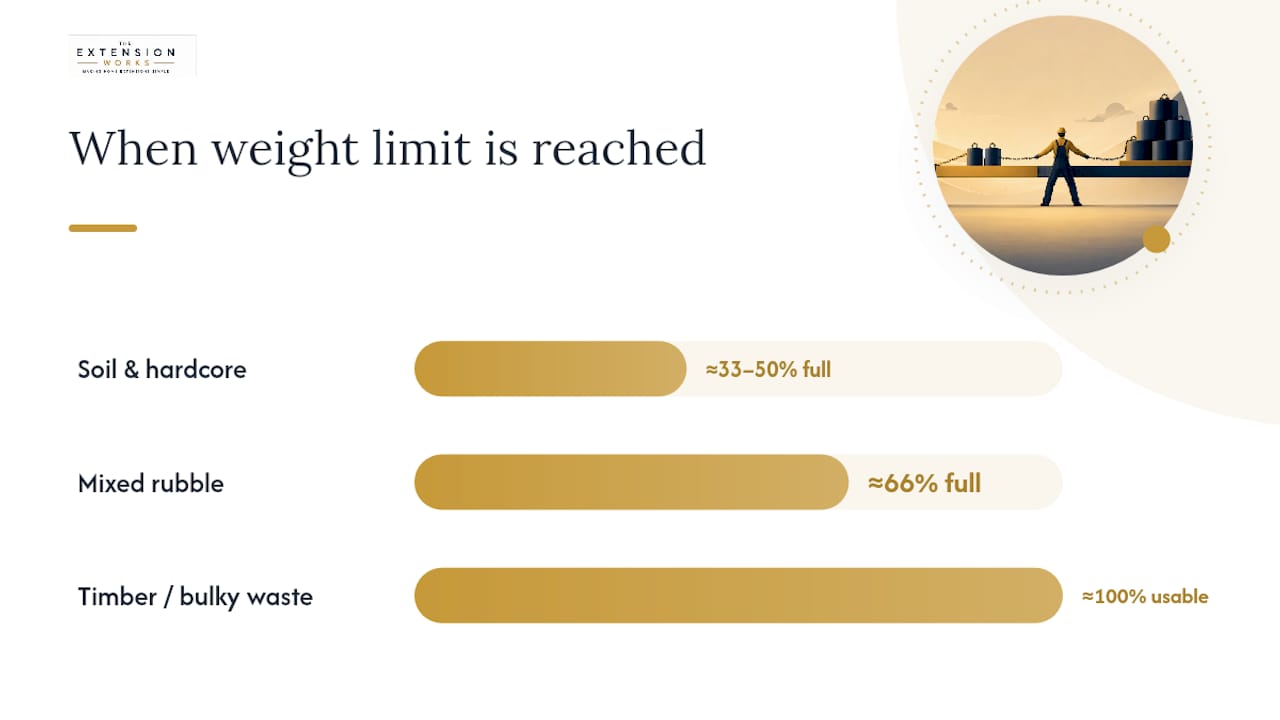
This is where a lot of extension projects go wrong. Skip hire companies charge and enforce by weight as well as volume, and dense material fills the weight allowance long before it fills the container. Soil and hardcore can hit the weight cap at around a third to half full, leaving you paying for a skip that still looks half empty.
Mixed rubble tends to reach its limit at around two-thirds full. Timber and other bulky light waste, by contrast, usually fills by volume long before weight becomes an issue, so an 8-yard skip genuinely gives you more usable space for that kind of job.
A few practical habits keep you on the right side of the limit:
- Spread material evenly rather than mounding it in one corner
- Break up large concrete or brick pieces so they pack down rather than sitting as awkward voids
- Load heavier material first, lighter material on top, to use the full weight allowance efficiently
- Ask your haulier for their specific weight limit when booking, since it varies by company and skip size
Pro Tip: If you already know a chunk of your project is heavy spoil, order a smaller skip specifically for that material rather than trying to squeeze it into the same 8-yard skip as your timber and packaging. You’ll often get more total capacity across two right-sized skips than one oversized one.
Exceed the weight limit and hauliers won’t just tut and drive off. Most will refuse collection until you remove material, or charge a significant excess weight fee once the skip’s weighed at the tip.
Do you need a permit for your skip?
If the skip sits entirely on your driveway or other private land without touching the pavement or road, you generally don’t need permission from anyone. The moment any part of it sits on the public highway, including the pavement outside your house, you need a licence from your local council. Placing one without permission is an offence, and fees and exact rules vary from one council to another.
Before the skip arrives, run through this checklist:
- Confirm whether your chosen spot counts as private land or highway with your council
- Check minimum clearance from junctions and driveways, since local guidance often specifies exact distances
- Make sure there’s enough overhead clearance for the lifting arm on delivery and collection
- Avoid siting the skip near zig-zag markings, bus stops or pedestrian crossings
- Ask about reflective markers and lighting requirements if the skip will sit out overnight
Working out site access early also matters if you’re still finalising your rear extension planning, since neighbour access and shared driveways often affect where a skip can realistically go.
| Placement | Permit needed? | Key check |
|---|---|---|
| Fully on driveway or private land | Usually no | Confirm boundary with council if unsure |
| Partly or fully on the road/pavement | Yes | Apply via GOV.UK before delivery |
| Near a junction or pedestrian crossing | Yes, and may be refused | Check local distance rules first |
How many skips will your extension actually need, and what will it cost?
A small single-storey extension, say a modest kitchen or utility addition, will often manage with one skip across the whole build if waste is staged sensibly. A typical single-storey rear extension usually needs one to two skips, depending on how much groundworks spoil there is and whether plasterboard needs separate handling.
Hire periods commonly run one to two weeks, and booking a fresh skip to match each build phase, rather than one skip sitting on site for months, tends to work out both cheaper and tidier. It also means you’re not stuck with a skip full of finishing-stage rubbish sitting there during the noisy demolition phase.
Indicative 2026 costs for domestic hire in England generally run:
- 6-yard skip: typically the cheaper option per hire, well suited to short, heavy-waste jobs
- 8-yard skip: a modest premium over the 6-yard, but often cheaper overall than hiring two smaller skips for mixed waste
A few things keep costs under control:
- Book collection promptly once a skip is full rather than letting hire periods run over
- Tell the haulier your dominant waste type at booking, since misdeclaring waste commonly leads to rejected collections or surcharges
- Combine a grab lorry for spoil with a smaller skip for everything else if your groundworks are extensive
What can’t go in your skip: asbestos, plasterboard and hazardous items
Standard mixed skips have real limits on what they can legally take, and getting this wrong can hold up your entire project. Items typically excluded include:
- Asbestos in any form, including older roofing sheets, textured coatings and pipe lagging
- Certain chemicals, solvents, paints and oils
- Fridges, freezers and some electricals containing refrigerants or batteries
- Plasterboard in bulk, unless your provider explicitly accepts it separately
Asbestos deserves particular care if your extension involves demolishing an older structure. HSE and government guidance requires sealed packaging and licensed removal, and putting suspected asbestos material into a general skip isn’t just risky, it’s unlawful.
Practical next steps if you encounter any of these:
- Get a licensed asbestos survey before demolition work starts on any pre-1990s structure
- Contact a licensed hazardous-waste contractor for removal rather than attempting to bag it yourself
- Check whether your local household recycling centre accepts smaller quantities of restricted items, which is often cheaper than a specialist collection
Grab lorries and skip bags: when a skip isn’t the right tool
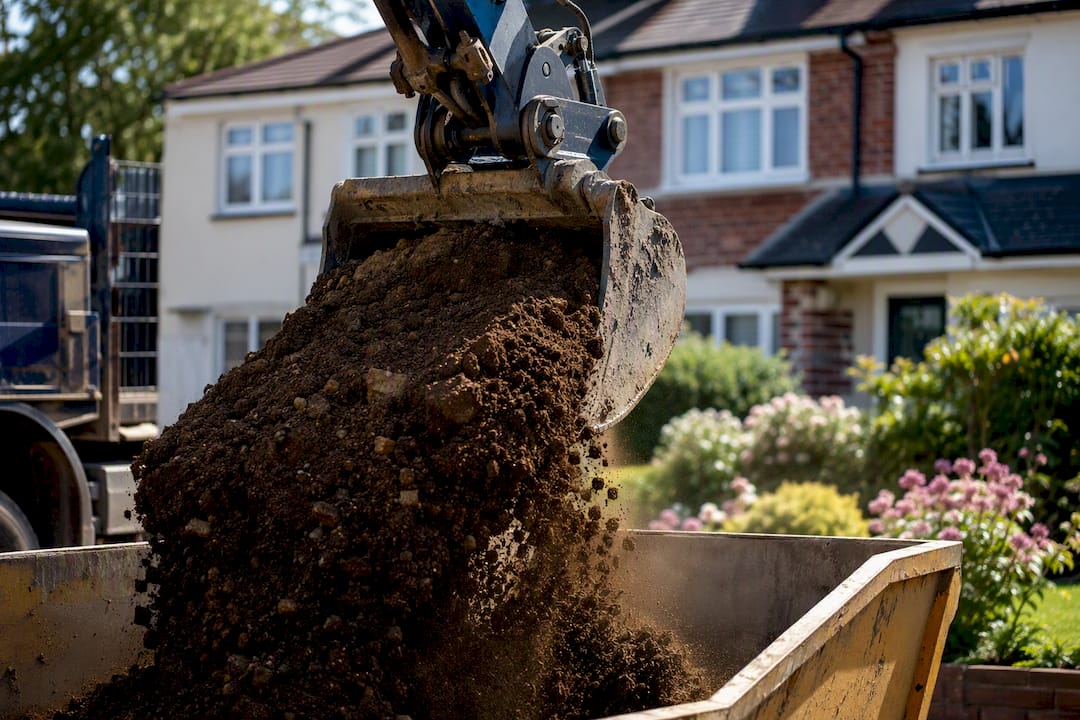
A skip isn’t always the best answer, particularly for groundworks. A grab lorry, which uses a hydraulic arm to lift material directly from a pile on your driveway or garden, works well for large volumes of soil or hardcore when you’re short on space or time. The lorry needs decent access and a firm surface to work from, so it’s less practical on narrow terraces or where the lorry can’t get close enough to reach the pile.
Skip bags, the smaller flexible alternative, suit projects generating modest amounts of waste over a longer period, or where a full skip would sit half empty for weeks. Dedicated plasterboard bags solve the separation problem without committing to a second full skip.
Combining methods often makes the most sense for a typical extension: a grab lorry clears the bulk of the excavated soil in one visit, while a 6 or 8-yard skip handles everything else across the build. That split keeps both costs and site clutter down.
Practical loading tips that cut skip hire costs
Staging waste removal by build phase, rather than booking one skip for the whole project, avoids paying for capacity you don’t need at the wrong time. Order a smaller skip for demolition and groundworks, then a fresh one for first fix and finishing.
When loading, put heavy, awkward material in first and flatten it down before adding lighter waste on top. Keep plasterboard and any potentially hazardous material separate from day one rather than trying to sort it out later.
- Load bulky, low-weight items like packaging last, once the base layer is compact
- Break down large boxes and cut long timber offcuts to save volume
- Tell your haulier the dominant waste type and rough weight expected when you book, not after delivery
Pro Tip: If you’re managing the build in phases, ask your skip provider whether they’ll guarantee next-day swap collections. That single detail can save you from a stalled site while you wait for a replacement skip.
Quick checklist: choosing your skip in five minutes
- Identify your dominant waste type: heavy spoil points to a 6-yard, mixed or light waste points to an 8-yard
- Measure your driveway or intended siting spot against the skip’s footprint
- Confirm with your council whether a highway permit applies to your chosen spot
- Check your haulier’s weight limit for the skip size you’ve picked
- Decide whether a single hire will cover the job or whether you need a second skip or a grab lorry for spoil
Ready to skip the skip headache entirely?
Get an instant online quote for your single-storey rear extension and let The Extension Works handle design, planning permission and site logistics, including the waste management decisions, as part of one fixed, VAT-inclusive price. Every project comes with a dedicated in-house team and a 12-month workmanship warranty, so you’re not left juggling skip permits and grab lorry bookings on top of everything else. Check the current extension rules for your property, or visit The Extension Works to see how the process works from first sketch to sign-off.
Where the standard advice on skip sizing falls short
Most guides treat skip sizing as a one-off decision: pick a number, book it, done. That’s the wrong frame for an extension. A build runs through genuinely different waste phases, heavy groundworks spoil, then timber and packaging, then finishing debris, and treating it as a single skip choice ignores that entirely.
The bin-bag equivalents you’ll see everywhere are useful shorthand, but they quietly assume mixed-density waste. Nobody’s project waste is evenly mixed. A driveway full of wet clay soil will max out a 6-yard skip’s weight allowance long before it looks anything like 55 bin bags’ worth, and that gap between the marketing number and the weighbridge slip is where budgets go wrong.
What actually matters is sequencing: staging skip hire against your build programme rather than committing to one container for the whole job. It costs slightly more admin upfront and saves money and site chaos later. Get your dominant waste type right at each phase, confirm the permit situation before the skip turns up, and the size question mostly answers itself.
— Esskay
Sources
- What Size Skip Do I Need for a House Extension or Building Work? — easySkip
- 6 vs 8 yard skip: which size do you need? — Rent‑a‑Skip
- Gov
Recommended
- Foundation depth for extension: what you need to know — The Extension Works
- Building work hours: a homeowner’s guide to faster extensions — The Extension Works
- Extension planning drawings: a homeowner’s guide — The Extension Works
- Structural calculations for extensions: the UK homeowner’s guide — The Extension Works